.webp)
SAP Course Details 2026: Fees, Duration, Eligibility, Salary & Career Scope
 Nidhi GuptaJun 5, 202616,408 views17 min read
The SAP Course is one of the best ways to create a successful corporate career by 2026. As companies across the globe continue to expand their technology infrastructures, the demand for ERP systems like SAP has never been greater. This course is one of the most popular professional trainings in IT and Business today, offering students a direct route to high-paying jobs in big companies. More than 90% of the Forbes Global 2000 use SAP software suites to fully integrate all of their key operational functions, including Finance, Human Resources, Supply Chain Management, Customer Relationship Management and Business Analytics.
This guide walks you through everything that you need to know to pursue an SAP Training program. You will gain insight into important details, qualifications, course format and fees, career paths and the latest trends within the industry.
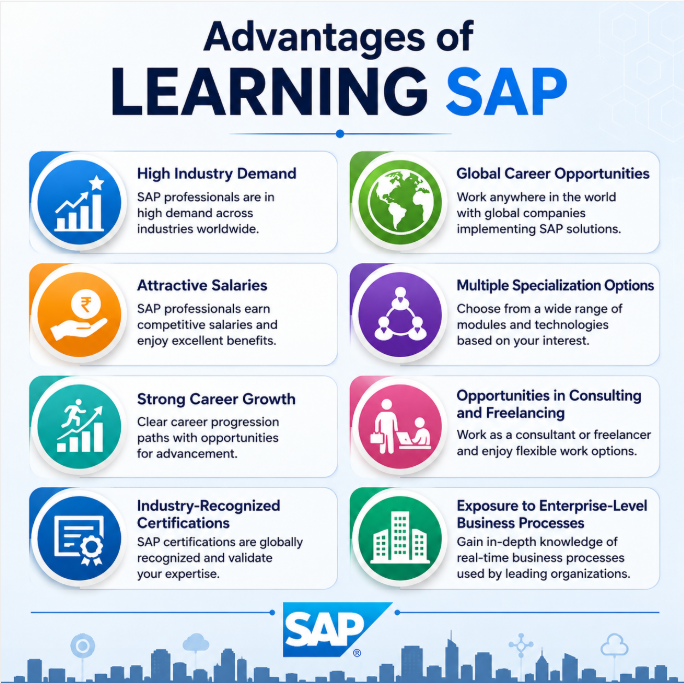
Advantages of Learning SAP
SAP Course Details
SAP course Details differ based on what module and specialisation you pick. They basically teach how to use, set up, and put SAP software to work across various business areas. There are two main types:
- Functional courses focus on specific business areas like finance, HR, sales, procurement, and production. You don’t need much coding knowledge for these.
- Technical SAP Program Related Courses focus on how to develop and customise SAP Systems, including ABAP, SAP Basis and SAP Netweaver.
Key SAP Course Details at a Glance:
Parameter | Details |
Course Type | Certificate / Diploma / Postgraduate |
Duration | 1 month to 1 year (module-dependent) |
Mode | Online, Offline, Hybrid |
Course Level | Beginner, Intermediate, Advanced |
Certification Body | SAP SE (Official) / Authorised Training Partners |
Average Fees in India | ₹25,000 to ₹3,50,000 |
| Average Starting Salary | ₹3.5 LPA to ₹7 LPA (Fresher) |
SAP Course Eligibility
A common question from candidates is: What are the SAP Course Eligibility requirements? Luckily, SAP has pretty flexible entry rules, so lots of people can join and learn.
Minimum Educational Qualification
- You need a Bachelor’s degree in something (like B.Com, B.Tech, BBA, BCA, or BSc).
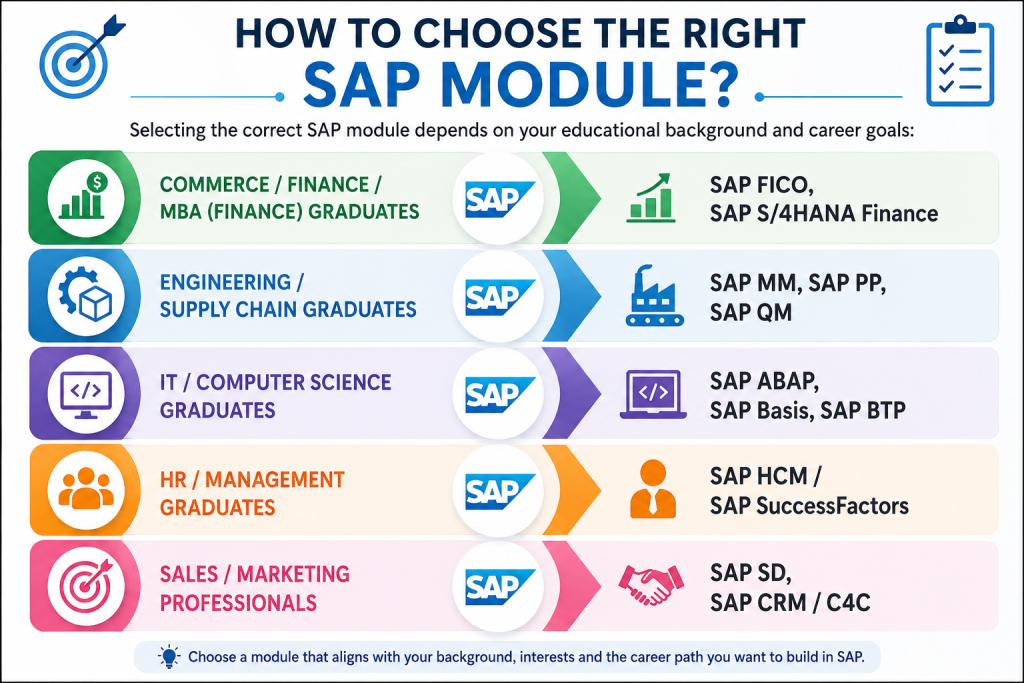
- For modules like SAP FICO or SAP HCM, studying Commerce, Finance, or getting an MBA helps.
- But for more tech-focused modules, such as SAP ABAP, they prefer you to have a Computer Science or IT background.
Work Experience
- Many SAP courses, particularly those at intermediate and advanced levels, suggest having one to three years of related work experience.
- However, certainly, freshers aren’t left out; they can join beginner or entry-level SAP programs too.
Technical Skills (for technical modules)
- For tech roles, knowing some coding in Java or C++ helps when you get to SAP ABAP or SAP Basis.
- Plus, being familiar with databases and operating systems is just a nice addition.
There is No Age Bar
The best part? There’s no age limit for getting into SAP training. So whether you’re 22 or 45, you can totally shift towards an ERP-focused career path.
Thinking About Learning SAP
Comprehensive SAP Course Syllabus
The SAP ecosystem is huge, so there isn’t one syllabus for everyone. Instead, it’s broken into modules, with each course zeroing in on a particular area like finance or tech. Let’s look at the key frameworks for the top paths in business today.
Functional Module Frameworks
A. SAP FICO (Financial Accounting & Controlling)
Since the beginning of enterprise resource planning, numerous companies worldwide have used Management Reporting, Performance Measurement, and Finance/Accounting application modules as foundational components of their enterprise systems. SAP FICO provides a framework for how the company can be able to do all of these things effectively. Companies can prepare the corporate financial statements, maintain audit trails, establish and monitor operational budgets, and provide detailed profitability reports.
- SAP FI (Financial Accounting) provides configurations for General Ledger (GL), Accounts Payable (AP), Accounts Receivable (AR), Asset Accounting, and Bank Accounting, including automated reconciliation of bank statements.
- SAP CO: (Controlling) provides configurations to support cost centre accounting (CCA), profit centre accounting (PCA), internal orders, product costing, and profitability analysis (CO-PA) metrics, which provide financial and operational information to assist management in making sound business decisions.
- Evolution of Finance within S/4HANA: An introduction to the architecture of the Universal Journal (ACDOCA table); and configuration of Central Finance, as well as real-time financial close processes.
B. SAP MM (Materials Management)
The basic functioning of the overall Procurement Engine is governed by this module; specifically, how the business acquires, manages, tracks and maintains raw materials and services.
- Master Data Management – Material Master files, Vendor Master databases, and Purchase Info Record configuration.
- Procurement Lifecycle – automated Purchase Requisition (PR), Request for Quotation (RFQ) processing, Purchase Order (PO) creation, and Release Strategy configurations.
- Inventory and Valuation Management – Goods Receipt (GR), Invoice Verification Procedures (LIV), physical inventory management and structural material valuation models.
C. SAP SD (Sales and Distribution)
SAP SD focuses on fulfilling orders from customers, encompassing the complete process from receiving a quote to delivering goods or services to customers and receiving payment for those goods or services.
- The overall structure of SAP SD includes a sales organisation that has various matrices based on its distribution channels, and it will map sales divisions and assign sales offices.
- The Order-to-Cash (O2C) cycle includes the inquiry tracking, quotation generation, standard order processing, delivery documentation, shipping control and final invoice to the customer.
- SAP SD also has an advanced pricing function, which includes condition technique setup, determination of pricing procedures, configuration of rebates and credit check settings.
Technical Module Frameworks
A. SAP ABAP (Advanced Business Application Programming)
The ABAP programming language forms the foundation for the SAP application layer. By learning ABAP, you will be prepared to develop solutions that extend and modify SAP Systems to support your company’s unique business requirements.
- ABAP Concepts: Procedural / Object Oriented ABAP includes syntax, variable scopes, looping structures, internal tables, and interfaces for object-oriented programming.
- To access and customize databases with ABAP, use Advanced Open SQL statements, build both classic and interactive report screens, and create user interfaces with dialog programs and module pools.
- Modern extensions to SAP S/4HANA are Core Data Services (CDS) Views, SAP Repo Objects, BAPIs (Business Application Programming Interfaces), BAdIs (enhancements framework), and SAP RESTful Application Programming Model (RAP).
B. SAP Basis (System Administration)
Basis provides an infrastructure and operating system for your SAP environment to provide security, high-performance, and availability of systems without any unplanned outages.
- The Basis architectural elements include SAP NetWeaver architecture, SAP instances, work processes configuration, and memory management profiles.
- The Database Administration components of Basis include the monitoring of SAP HANA databases and backup architecture, restoration procedure, and standard index tuning.
- User management and security include things like Central User Administration, setting up complex roles, configuring authentication objects, and standard TMS setups. Managing users and security is a major task because it involves getting all these parts to work together correctly.
- According to a Strategic Insight perspective on SAP for 2026, there is now a heavier emphasis on cloud integration with modern SAP deployments.
- Understanding the fundamentals of SAP BTP(Business Technology Platform) and cloud native extensions will help you significantly in your marketability vs other certified individuals who are only certified on legacy products.
SAP Course Fees
SAP Course Fees inIndia vary significantly based on the institute, location, mode of learning, and the specific module chosen. Here is a general overview:
SAP Course Fees in India (2025–2026)
Module | Approximate Fees |
₹35,000 – ₹80,000 | |
₹30,000 – ₹70,000 | |
₹30,000 – ₹70,000 | |
₹40,000 – ₹90,000 | |
₹50,000 – ₹1,50,000 | |
SAP HR/HCM | ₹30,000 – ₹65,000 |
₹35,000 – ₹75,000 | |
SAP Official Certification (Global) | ₹30,000 – ₹80,000 per exam |
The overall price range for SAP courses in India runs anywhere between ₹25,000 and ₹3,50,000, depending on the course module and the institute. Online courses on sites like Coursera and Udemy usually cost less, whereas instructor-guided classes with job placement help from reputable schools are more expensive, so the pricing differs based on the support offered.
Tip: Many SAP-authorised training partners offer EMI options and scholarships. It is always worth asking about instalment plans before enrolling.
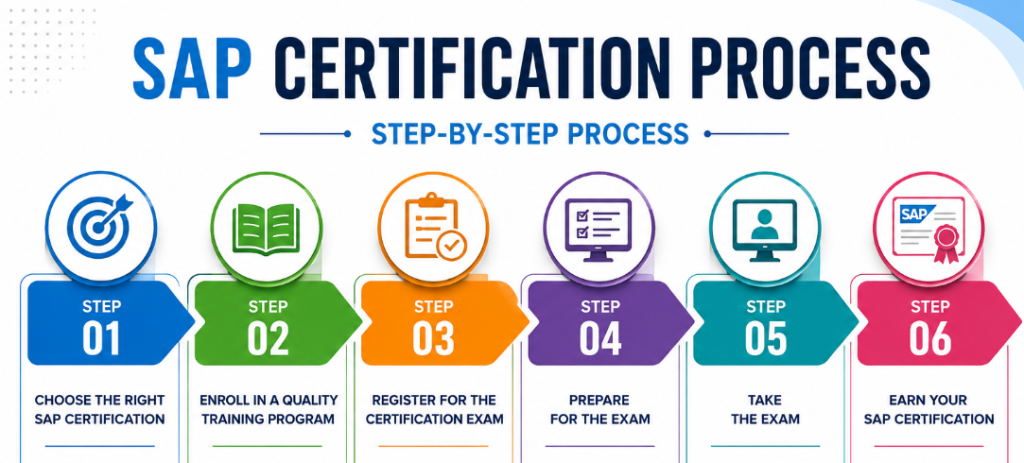
SAP Certification Process
The SAP certification program enables individuals to authenticate their knowledge and proficiency in particular SAP modules. It is highly valued by employers all around the world and can open up many career options.
- Firstly, it is necessary to select the appropriate SAP certification according to one’s profession and experience. Some of the widely preferred SAP certifications include SAP FICO, SAP MM, SAP SD, SAP ABAP, SAP S/4HANA, SAP SuccessFactors, SAP Ariba, and SAP Basis.
- Afterwards, you should sign up for a credible SAP training course that includes the theoretical as well as practical aspects of the SAP modules.
- When you have completed your training, sign up for the appropriate exam on the SAP Certification website. SAP certification exams can be taken either online or through authorised testing centres.
- SAP certification exams involve multiple-choice questions where you are expected to demonstrate your knowledge of SAP concepts, business processes, and functionality. It is recommended that you study from SAP resources, take mock exams, and go through sample questions.
- On passing your exam, you will get an SAP certification. Staying updated with your SAP certification by studying and upgrading based on new SAP versions helps you stay current with SAP technologies.
Ready to Start Learning SAP
Top SAP Modules to Consider in 2026
The number of SAP implementations in India has increased annually at a rate of 25%. Therefore, the right SAP module will influence how much money you will make going forward. Here is a list of the top modules to choose from:
- SAP FICOis currently the most broadly used SAP Module. This is a good choice for individuals with a degree in Commerce or Finance and offers salaries in the range of ₹18–25 LPA at senior levels.
- SAP S/4HANA continues to achieve growth at an above-average rate. The large majority of businesses in India are currently upgrading from their old ECC system to S/4HANA, due to the impending deadline (2027) for SAP to stop supporting the ECC system. This will contribute to a high level of future demand for professionals experienced in SAP S/4HANA.
- SAP MM is a primary SAP module used in the areas of manufacturing, retail, and logistics. Professionals with SAP MM experience can expect to earn an annual salary of ₹6–15 LPA, while those at a senior level can expect to earn between ₹18–30 LPA.
- SAP SD is a SAP Module that covers the entire end-to-end sales and distribution process. Those with mid-level experience in SAP SD can expect to earn a salary range of ₹5.5–14 LPA, while those at a senior level will earn 25+ LPA.
- SAP ABAP is the primary SAP development module, and it is one of the highest-paid technical SAP modules globally. The average annual salary for SAP ABAP professionals around the world is between $85,000 and$140,000.
- SAP QM (Quality Management) is experiencing a growing demand from the pharmaceutical and manufacturing sectors and can be used in all industries. The average SAP QM salary in India is approximated to be ₹9.1 LPA.
SAP Career Opportunities
By completing an SAP Training course, you will gain access to many job roles that are in high demand. Certainly, you can find many great options available, such as
- SAP Functional Consultant — Responsible for implementing and configuring specific SAP modules for the client organisation.
- SAP Technical Consultant/ABAP Developer — Responsible for customising the SAP system through programming.
- SAP Basis Administrator — Responsible for managing the technical infrastructure and administration of your organisation’s SAP systems.
- SAP Project Manager — Responsible for overseeing end-to-end implementation of SAP projects.
- SAP Business Analyst — Responsible for bridging the gap between business needs and SAP solutions.
- SAP Solutions Architect — Responsible for developing SAP landscapes for large enterprises.
- SAP Trainer — Responsible for implementing end-user and technical training programs.
The top companies worldwide that are hiring SAP professionals include TCS, Wipro, Infosys, Deloitte, Accenture, IBM, Capgemini, as well as hundreds of mid-sized IT companies that work directly with mid-size corporations in Banking and Finance, Manufacturing, Retail, Healthcare, and Fast-Moving Consumer Goods (FMCG).
SAP Salary in India and Globally
Salary is one of the strongest reasons to pursue an SAP Certification course. Here is a realistic snapshot of SAP salaries in 2026:
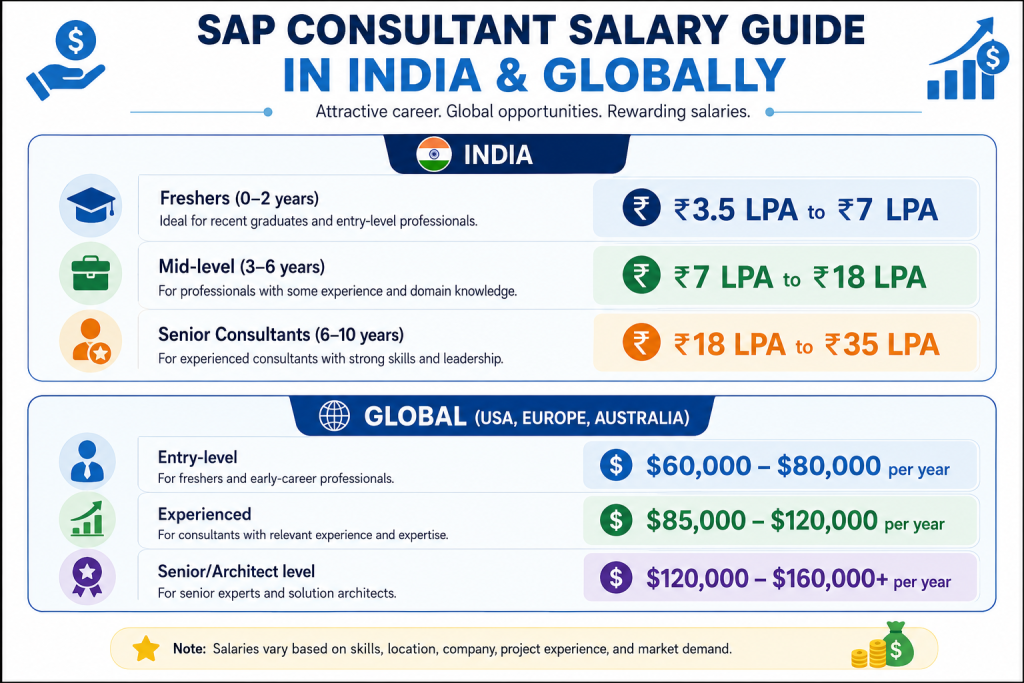
Cities like Bangalore, Hyderabad, and Pune offer 35% higher SAP salaries than other metros in India, making them the prime destinations for SAP professionals.
SAP Course Scope
The SAP Training Courses Scope in 2025-2026 looks really promising, thanks to some big trends.
- Digital Transformation Wave: Corporations of every shape and size are digitising their operations, and SAP has become the most popular software choice to implement large-scale ERP solutions. SAP is now being adopted by even small to medium-sized businesses, significantly increasing the number of professionals that companies can hire.
- SAP S/4HANA Migration Deadline: SAP has established a date to stop providing mainstream maintenance for its legacy ECC platform, which will be by 2027. Due to this announcement, there has been a large influx of companies worldwide that are undergoing migration projects, and the demand for certified professionals who understand S/4HANA or have SAP Migration skills has increased tremendously.
- Cloud and AI Integration: SAP’s cloud offerings combined with AI, machine learning, and real-time analytics make SAP much more robust than before. SAP professionals who have knowledge of SAP BTP (Business Technologies Platform) and AI-enhanced Fiori Apps skills are in high demand.
- India’s ERP Market Growth: The ERP market in India is set to grow at 11% CAGR. SAP maintains the majority market share in this ERP market. Therefore, since approximately 70% of Indian enterprises run SAP, there is a consistent and growing need for SAP-trained professionals.
- Global Opportunities: SAP professionals’ skills are recognised all over the world. Certified SAP professionals have the ability to obtain jobs in the USA, UK, Germany, Australia, UAE and Singapore, which makes it an excellent skill to advance your career globally.
How to Choose the Right SAP Module?
Eduwatts- The Best SAP Training Institute

Eduwatts is a renowned institution offering professional training courses on SAP. Their SAP Training is designed to positively impact your career, whether you are a Student or a Professional interested in working in the SAP field. Their focus is on creating industry-relevant training materials that will assist you in obtaining your professional certification from SAP.
Eduwatts offers many key benefits concerning training in SAP:
- Instructor-Led/SAP Certified Training
- Real World Case Studies and Assignments
- Exposure to Industry-Relevant SAP Tools
- Support & Guidance for SAP Certification Exams
- Multiple Trainers Instruction
- Industry-Focused Learning
- Opportunities to Apply Knowledge to Actual Business Scenarios
- Support for Both New Graduates and Currently Employed Professionals
Whether you are a Student just entering ERP or a Working Professional trying to advance to your next level, Eduwatts will provide the Information and Experience you need to excel in the network of competitive companies that make up the SAP Economy. With their customer-focused motto and dedication to being top-notch, Eduwatts is a go-to for SAP hopefuls both in India and overseas.
Talk to a SAP Course Expert
Tips for Success in Your SAP Career
Certifications are only the first step in developing a career in SAP. Here’s a list of easy and practical tips to assist you in developing a successful SAP job:
- Participate in real world project work while you are attending or after you complete your SAP training; the more experience you have, the easier it will be to find future employment.
- Obtain your official SAP certification; it may allow you to earn 30-50% more money and give you greater credibility with employers and clients.
- Keep up with SAP’s current releases of their software and new releases of S/4HANA and SAP BTP (SAP Business Technologies).
- Develop your skills in your particular domain area of expertise and SAP to increase your desirability as an employee (for example: Finance expertise + SAP FICO = High value).
- Network with other SAP professionals on LinkedIn and contribute to the SAP community forums.
- Try to understand the different SAP modules over time so that you can be a consultant with multiple skills.
Latest SAP Market Demand (2026)
The demand for SAP professionals is increasing year by year in 2026 as companies focus on digitisation, cloud computing, and intelligent ERP applications. These are some of the major market trends impacting the future of SAP careers.
1. Rise in SAP Adoption by Enterprises
Organizations are migrating from older ERP platforms to SAP S/4HANA.
Organizations utilize SAP for streamlining processes and making data-driven decisions.
Aerospace, manufacturing, retail, healthcare, banking, logistics, and government sectors have continued to make large investments in SAP.
Popular SAP Platforms
The following SAP platforms have seen high demand:
- SAP S/4HANA
- SAP SuccessFactors
- SAP Ariba
- SAP BTP
- SAP Analytics Cloud
- SAP IBP
2. Top in-demand SAP roles
Organizations are looking to hire:
- SAP Functional Consultants
- SAP Technical Consultants
- SAP ABAP Developers
- SAP Basis Administrators
- SAP Project Managers
- SAP Implementation Specialists
- SAP Business Analysts
- Role Driven by AI and Cloud
The automation enabled by AI is changing the way SAP systems are being implemented. There will be continued opportunities due to cloud migration projects. Organizations are seeking individuals skilled in analysis, automation, and business process management.
3. Great Career Prospects
India continues to be one of the major talent pools for SAP, with multinationals, IT organizations, consultancies, and Global Capability Centers (GCC) hiring SAP-certified professionals. Individuals who possess SAP certification along with practical experience in modules such as FICO, MM, SD, ABAP, HANA, and SuccessFactors can look forward to good career prospects, lucrative salaries, and growth until 2026.
Conclusion
SAP Certification program helps in transforming your career by giving you the global recognition of having skills in Enterprise Software. The ERP (Enterprise Resource Planning) industry is experiencing an upsurge in India with the deadline for S/4HANA migration approaching quickly (2027) and has created considerable demand for SAP professionals. In addition, salaries are getting significantly higher (₹3.5 LPA for fresh graduates to ₹35+ LPA for experienced consultants). Therefore, there is no better time to take SAP training courses.
This guide covers everything for starting with SAP. It includes an intro course, training, info on requirements and syllabus, fees, and the long-term value and job prospects of an SAP cert. So, you’ll know what to expect when getting certified.
Make sure you research and understand what is required for your specific module choice, be committed to a quality training program, obtain your SAP certification and step into probably one of the most in-demand career paths over the next decade.
Recommended Reads
- SAP Ariba Course: Introduction, Modules, Fees, and Features
- SAP Consultant Salary in India
- How To Become an SAP Ariba Consultant (With Duties and Skills)
- Top SAP Modules List for a High-Paying Career in 2026
- Top 10+ SAP SCM Course Online: 2026
FAQs
SAP course is a professional development curriculum covering the usage of SAP Software tools to administer business functions such as finance, sales, procurement, h/r and supply chain management.
SAP courses may be taken by graduates, post-graduates, working professionals, engineers, students in commerce, MBAs and IT professionals. The proper module to choose depends on your background and career aspirations.
The duration of an SAP course is usually 1 to 6 months, depending on what module is being taught, the type of training offered and how quickly you are able to learn.
The following are examples of very popular SAP Modules: SAP FICO, SAP MM, SAP SD, SAP ABAP, SAP BASIS, SAP HCM, SAP SuccessFactors, SAP S/4HANA.
The fee for an SAP course can be from Rs 20,000 to Rs 2,00,000 or higher depending on; which module and where the training will be held; whether or not the class offers preparation for certification.
Ready to Start Your Learning Journey?
Join thousands of learners and build your future with expert-led courses and 100% practical training.

Nidhi Gupta
I am a full-time content writer who develops high-quality, engaging and SEO-friendly content for the Internet. The type of content I write includes blogs, articles, website content, and marketing content which educates customers and helps companies build their online presence. My specialty lies in developing high-value, well-researched and audience-oriented content. Apart from being an all-round professional content writer, I have vast experience in **healthcare content writing** where I develop highly accurate and customer-friendly content on hospitals, doctors, various medical specialties, diseases, healthcare courses and patient education material. I make sure each and every medical content I develop is well-researched, easy-to-understand and in line with the latest developments in the field of healthcare. Moreover, apart from health care writing, I have thorough knowledge about SAP concepts including SAP ERP and other business processes and enterprise solutions where I develop highly informative content related to SAP modules, digital transformation, business analytics and enterprise software.
View all articles




Recent Comments (20)
Important details about SAP eligibility, syllabus and prospective careers.
Good learning for anyone considering SAP as a career or more futureproof career.
It is a informative article with all the necessary details of SAP courses along with their advantages.
Excellent SAP training overview, job prospects and demand in the industry.
This article simply answers most of the questions surrounding SAP courses.
Great work! These are really practical, usable content
The detailed analysis of SAP fees and scope is very useful.
The ideal handbook for anybody who wishes to kick off a lucrative vocation within SAP.
This article helps you to identify the right course in SAP depending on your career objective.
Important details about SAP eligibility, syllabus and prospective careers.
One of the best articles to understand about entire SAP learning path
I like how the SAP course details are explained clearly here.
Useful resource for students and practitioners seeking to learn additional skills on top of SAP.
The career prospects cited in this article are extremely motivating.
An excellent and detailed guide for SAP aspirants.
Excellent content! The information on fees and scope is also super helpful.
This article will help those who are looking for a career in SAP domain.
Answer Eligibility and Syllabus explained in a simple way
Awesome tutorial for anyone starting and want exposure into SAP courses and career options.
Very informative article! It contains all the important components for SAP in one place.