.webp)
Top 90+ Basic French Words Every Beginner Must Know
 Nidhi GuptaOct 5, 2026993 views15 min read
The French words are the basics of learning French, which aid new learners in comprehending conversations, creating sentences, and speaking with confidence. Irrespective of the reasons why you would like to learn French for travelling, academic purposes, business, or even personal ones, learning the right vocabulary makes the process much easier.
French is among the widely learned languages in the world. You do not have to know thousands of words at once. Start with the basics like greetings, people, numbers, food, places, time, questions, and general conversation vocabulary. After understanding the basic words in the French language, you will be able to increase your vocabulary and grammar slowly. Qui? Who? Quoi? / Que? What? Où? Where? Quand? When? Pourquoi? Why? Comment? How? Combien? How much / How many? Lequel / Laquelle? Which one?
This article highlights 90+ French basic words with their meanings, pronunciation tips, and example sentences that will enable you to start speaking French.
What Are the Most Common French Words?
The most frequent words in French are: le/la (the), de (of), et (and), être (to be), avoir (to have), je (I), vous (you), oui (yes), non (no), merci (thanks), and bonjour (hello). Memorizing these words will give you the best results in your studies.
Why Should Beginners Learn Basic Words in French?
French language basic words are great starting point before getting into advanced French grammar and vocabulary. When you are aware of commonly used words, you will be able to catch familiar phrases when you listen and read.
For instance, having a basic knowledge of words like bonjour (hello), merci (thank you), oui (yes), and non (no) will help you deal with simple communications from the first days of your French lessons.
Vocabulary is needed for constructing sentences as well. When you get to know words for “I”, “want”, “water” and “please”, you will be able to construct some useful phrases even without mastering the grammar.
An effective way to study vocabulary is learning them in sets and using in sentences. A Post Graduate Diploma in French Languageis the best option to start learning French Langauge from scratch.
Thinking About Learning French?
90+ Basic French Words for Beginners
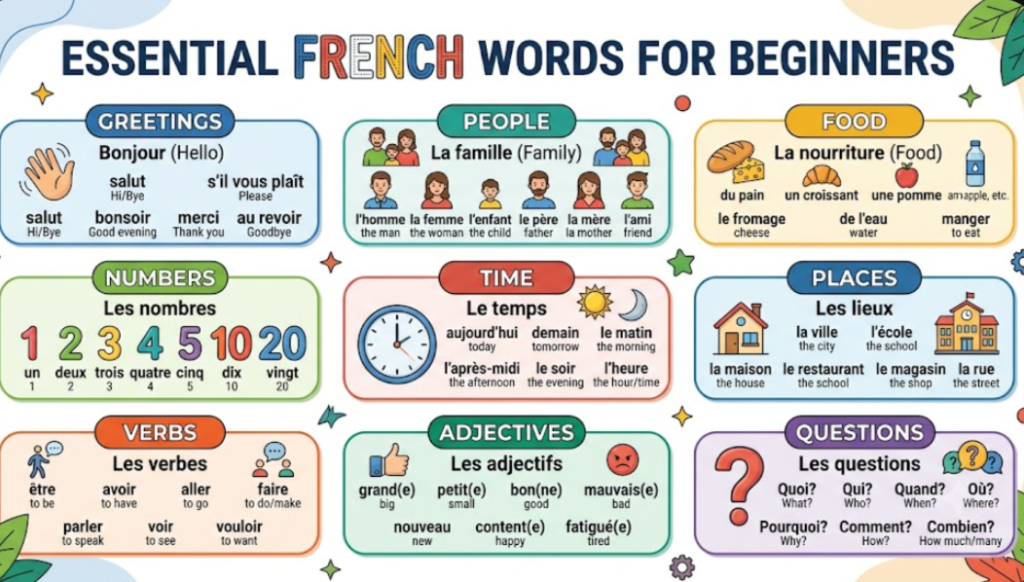
These are some of the most helpful words in French for beginners to learn.
1. Common French Greetings
Greetings are among the first words you should learn when studying French.
| French Word | English Meaning | Example |
| Bonjour | Hello / Good morning | Bonjour, Madame. |
| Salut | Hi / Bye | Salut, comment ça va ? |
| Bonsoir | Good evening | Bonsoir, Monsieur. |
| Au revoir | Goodbye | Au revoir ! |
| Merci | Thank you | Merci beaucoup. |
| Pardon | Sorry / Excuse me | Pardon, Madame. |
| S’il vous plaît | Please | Un café, s’il vous plaît. |
| Bienvenue | Welcome | Bienvenue en France. |
| À bientôt | See you soon | À bientôt ! |
| Bonne nuit | Good night | Bonne nuit, mon ami. |
These words in French are commonly used in restaurants, stores, classrooms, hotels, and in daily conversations.
2. Basic French Pronouns
Certainly, with the help of pronouns, you can talk about yourself and other people.
| French Word | English Meaning |
| Je | I |
| Tu | You |
| Il | He |
| Elle | She |
| Nous | We |
| Vous | You / You formal |
| Ils | They, masculine/mixed |
| Elles | They, feminine |
| On | One / We / People |
For example:
- Je suis étudiant. – I am a student.
- Tu es mon ami. – You are my friend.
- Elle est française. – She is French.
- Nous sommes prêts. – We are ready.
Moreover, early learning of pronouns facilitates comprehension of French verb conjugations.
3. Useful French Question Words
Questions are important for communication. Here are some of the most valuable question words for novices.
| French Word | English Meaning |
| Qui | Who |
| Que | What |
| Quoi | What |
| Où | Where |
| Quand | When |
| Pourquoi | Why |
| Comment | How |
| Combien | How much / How many |
| Quel | Which / What, masculine |
| Quelle | Which / What, feminine |
Examples:
Où est la gare ? – Where is the station?
Comment allez-vous ? – How are you?
Combien ça coûte ? – How much does it cost?
Pourquoi ? – Why?
This is because these words are common in spoken French, thus constituting basic French language vocabulary.
4. Essential French Yes and No Words
The easiest words in French are sometimes the most practical.
| French Word | English Meaning |
| Oui | Yes |
| Non | No |
| Peut-être | Maybe |
| Bien sûr | Of course |
| D’accord | Okay / Agreed |
| Vraiment | Really |
| Aussi | Also |
| Encore | Again / Still |
| Très | Very |
| Beaucoup | A lot / Much |
For example:
Oui, bien sûr. – Yes, of course.
Non, merci. – No, thank you.
D’accord ! – Okay!
5. Common French Words for People
Understanding words about individuals gives you the ability to talk about your relatives and social connections.
| French Word | English Meaning |
| Homme | Man |
| Femme | Woman |
| Enfant | Child |
| Garçon | Boy |
| Fille | Girl |
| Ami | Friend, masculine |
| Amie | Friend, feminine |
| Famille | Family |
| Père | Father |
| Mère | Mother |
| Frère | Brother |
| Sœur | Sister |
| Monsieur | Mr. / Sir |
| Madame | Mrs. / Madam |
| Enfant | Child |
Example:
Ma famille est grande. – My family is large.
C’est mon frère. – This is my brother.
6. Important words in French for Everyday Objects
Knowledge of common nouns assists you in comprehending conversations and signs.
| French Word | English Meaning |
| Maison | House |
| École | School |
| Livre | Book |
| Table | Table |
| Chaise | Chair |
| Porte | Door |
| Fenêtre | Window |
| Voiture | Car |
| Téléphone | Phone |
| Sac | Bag |
| Eau | Water |
| Pain | Bread |
| Café | Coffee |
| Argent | Money |
| Travail | Work |
These words are often used in basic French conversations.
7. Basic French Words for Food and Drinks
Knowing terms related to food is especially helpful if one travels to a country where French is spoken.
| French Word | English Meaning |
| Eau | Water |
| Pain | Bread |
| Fromage | Cheese |
| Lait | Milk |
| Café | Coffee |
| Thé | Tea |
| Vin | Wine |
| Pomme | Apple |
| Banane | Banana |
| Viande | Meat |
| Poisson | Fish |
| Riz | Rice |
| Poulet | Chicken |
| Sucre | Sugar |
| Sel | Salt |
Useful expressions include:
Je voudrais un café. – I would like a coffee.
De l’eau, s’il vous plaît. – Water, please.
J’aime le fromage. – I like cheese.
8. French Numbers Every Beginner Should Know
Certainly, French Numbers are needed to shop, tell time, state your age, talk about costs, and make arrangements.
| Number | French |
| 1 | Un |
| 2 | Deux |
| 3 | Trois |
| 4 | Quatre |
| 5 | Cinq |
| 6 | Six |
| 7 | Sept |
| 8 | Huit |
| 9 | Neuf |
| 10 | Dix |
| 11 | Onze |
| 12 | Douze |
| 13 | Treize |
| 14 | Quatorze |
| 15 | Quinze |
| 16 | Seize |
| 20 | Vingt |
After learning the numbers between one and twenty, you can start learning larger numbers and also get an idea about prices, dates, and addresses.
Ready to Start Learning French?
9. Useful French Words for Time
Time-related vocabulary appears constantly in everyday conversations.
| French Word | English Meaning |
| Aujourd’hui | Today |
| Demain | Tomorrow |
| Hier | Yesterday |
| Maintenant | Now |
| Matin | Morning |
| Après-midi | Afternoon |
| Soir | Evening |
| Nuit | Night |
| Jour | Day |
| Semaine | Week |
| Mois | Month |
| Année | Year |
| Heure | Hour / Time |
| Minute | Minute |
Examples:
À demain ! – See you tomorrow!
À quelle heure ? – At what time?
Aujourd’hui, je travaille. – Today, I work.
10. Basic French Adjectives
Adjectives help you describe people, objects, places, and experiences.
| French Word | English Meaning |
| Bon | Good |
| Mauvais | Bad |
| Grand | Big / Tall |
| Petit | Small / Short |
| Beau | Beautiful / Handsome |
| Joli | Pretty |
| Nouveau | New |
| Vieux | Old |
| Jeune | Young |
| Facile | Easy |
| Difficile | Difficult |
| Heureux | Happy |
| Triste | Sad |
| Chaud | Hot / Warm |
| Froid | Cold |
Examples:
C’est facile. – It is easy.
La maison est grande. – The house is big.
Il est heureux. – He is happy.
11. Essential French Verbs
Verbs allow you to express actions, needs, preferences, and experiences.
| French Verb | English Meaning |
| Être | To be |
| Avoir | To have |
| Aller | To go |
| Faire | To do / Make |
| Parler | To speak |
| Aimer | To like / Love |
| Vouloir | To want |
| Pouvoir | To be able to / Can |
| Savoir | To know |
| Comprendre | To understand |
| Manger | To eat |
| Boire | To drink |
| Dormir | To sleep |
| Travailler | To work |
| Étudier | To study |
For example:
Je parle français. – I speak French.
J’aime le français. – I like French.
Je veux apprendre. – I want to learn.
Je comprends. – I understand.
12. Words in French for Places
Place-related vocabulary can help you navigate cities and travel situations.
| French Word | English Meaning |
| Gare | Train station |
| Aéroport | Airport |
| Hôtel | Hotel |
| Restaurant | Restaurant |
| École | School |
| Hôpital | Hospital |
| Banque | Bank |
| Magasin | Shop / Store |
| Rue | Street |
| Ville | City |
| Pays | Country |
| Parc | Park |
| Plage | Beach |
A useful sentence is:
Où est l’hôtel ? – Where is the hotel?
Famous French Words Beginners Often Recognise
Several well-known words in French have gained universal recognition despite the fact that many non-French speakers use them.
For instance,
- Bonjour – Hello
- Merci – Thank you
- Croissant – Croissant
- Baguette – Baguette
- Café – Coffee
- Amour – Love
- Chic – Stylish
- Merci beaucoup – Thank you very much
- Déjà vu – Already seen
- Voilà – There you go / There it is
There are many other French terms that are used in the English language due to the influence of French on the English vocabulary.
Famous French Words Used in English
There are many words in French that have become popular English words, giving you an advantage right from the start. You may be familiar with some of the following:
- Café, restaurant, menu, and cuisine
- Déjà vu (already seen)
- Rendezvous (a meeting)
- Entrepreneur, souvenir, and boutique
- Bon voyage (enjoy your journey)
- C’est la vie (that’s life)
- Joie de vivre (joy of living)
- Voilà (there it is)
These cognates demonstrate that you know more French than you realize already. In fact, about one-third of English vocabulary consists of French and Latin origins due to the Norman influence on English.
How to Learn Basic French Words Faster?
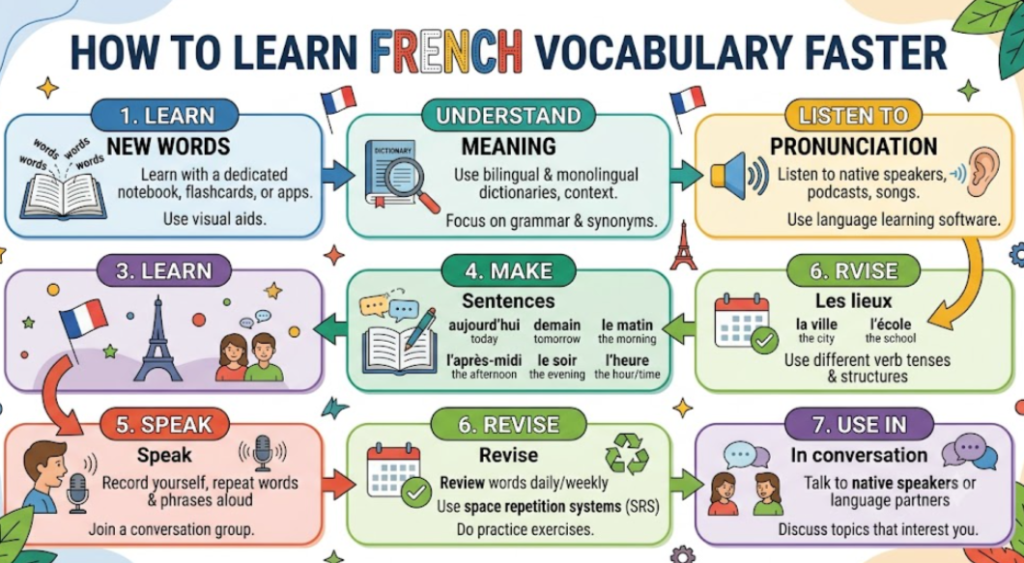
Even if you have learned many words in a French vocabulary list, that does not mean you can now speak French. This will require active work with new words.
1. Group Vocabulary by Themes
It is not necessary to remember random French vocabulary. Try to group them into themes: food, family, numbers, travel, and greetings.
2. Apply Words to Sentences
Do not learn maison = house and end here. Make a sentence:
Ma maison est grande. – My house is big.
The context will facilitate the learning process.
3. Practise the Pronunciation
The pronunciation of French is quite different from the pronunciation of English. Listen to native speakers and pronounce the words yourself.
4. Use Flashcards
Make digital or paper flashcards with French on one side and English on another. Check your knowledge regularly.
5. Speak French Everyday
Even five to ten minutes a day will be useful. Describe your environment, introduce yourself or just say something about your day using French vocabulary.
6. Master High-Frequency Vocabulary
Begin with words that you are most likely to meet. It will be easier to learn 100 useful words rather than 100 rare words.
How Many French Words Are There?
One question that newbies ask is how many French words there are.
There cannot be an exact number since all dictionaries have their own criteria for word-counting, and languages are not static, they evolve continuously with new words coming up while old ones disappearing.
What matters for beginners is not an exact number of words in French.
One can communicate effectively in most situations using a limited vocabulary base and building upon it.
It is better to concentrate on common words in french rather than learn all the words in the language.
How Many words in French Do You Need to Speak French?
One does not have to learn all words in French in order to speak the language effectively.
A beginner can begin talking by learning several hundreds of frequently used words and sentences. With an increasing vocabulary, you will be able to talk about more subjects.
The trick here lies in combining vocabulary with other aspects of learning such as French Grammar, pronunciation, etc.
Basic French Words and Phrases for Daily Conversation
Here are some practical basic French words and phrases you can start using immediately:
Bonjour ! – Hello!
Comment ça va ? – How are you?
Ça va bien. – I am doing well.
Merci beaucoup. – Thank you very much.
S’il vous plaît. – Please.
Excusez-moi. – Excuse me.
Je m’appelle Anna. – My name is Anna.
Je ne comprends pas. – I do not understand.
Pouvez-vous répéter ? – Can you repeat?
Parlez-vous anglais ? – Do you speak English?
Combien ça coûte ? – How much does it cost?
Où est la gare ? – Where is the station?
Je voudrais un café. – I would like a coffee.
À bientôt ! – See you soon!
Learning these phrases gives beginners a practical starting point for real-life communication.
Pronunciation Tips for Beginners
French pronunciation might sound difficult, but there are just a few guidelines that can help a lot:
- Silent final consonant. In general, the last consonant is not pronounced in most cases. Petit would be pronounced as “puh-tee.”
- Liaison. A usually silent consonant becomes voiced before a vowel. Vous avez would be pronounced as “voo-za-vay.”
- Nasal vowels. The sounds such as on, an, and in reverberate through the nose, like in bon, enfant, and vin.
- French r. It is rolled at the back of the throat, much like a gargle.
- Accents are important. é, è, ê, à, ç, and ù influence pronunciation and even have different meanings (ou is “or” whereas où is “where”).
Podcasts, songs, and videos featuring native speakers can train your ear the best.
A Simple 7-Day Plan to Learn French Vocabulary
Your vocabulary practice can be scheduled according to the following weekly plan.
| Day | Vocabulary Focus |
| Day 1 | Greetings and polite expressions |
| Day 2 | Pronouns and people |
| Day 3 | Numbers and time |
| Day 4 | Food and drinks |
| Day 5 | Places and travel |
| Day 6 | Common verbs and adjectives |
| Day 7 | Revision and conversation practice |
Give 15 to 20 minutes each day to vocabulary review. After that, try to use 5 to 10 new words in sentences yourself.
Eduwatts French Language Course – Why Is It One of the Best Ways to Learn French?

French language learning becomes simple with a well-designed course which includes practice sessions, teaching from experts, and speaking sessions. The Eduwatts French Language Course allows learners to go through an organized program to develop their French language vocabulary, grammar, pronunciation, reading, writing, listening, and speaking abilities.
If you are a beginner in the French language or wish to upgrade your current level of French, then a guided French Language course will assist you in developing French vocabulary and phrases systematically rather than randomly.
Reasons for Choosing the Eduwatts French Language Course
1. Systematic French Language Learning
The course offers a systematic way to learn French, from the basics of French language vocabulary and grammar through to higher-level conversation skills. It is easy for newcomers to comprehend French language skills step by step.
Talk to a French Course Expert
2. Practical French Learning
French learning is not only about memorization of vocabulary. Learners should know how to apply words and phrases in conversation practice. Eduwatts pays special attention to practical language skills so that students could get more confident in applying French language in day-to-day life.
3. Expand French Vocabulary
It is possible to expand one’s vocabulary by learning popular French language words, phrases, and expressions. This knowledge will help you to understand what is being said and make sentences.
4. Polish French Pronunciation
French language pronunciation may seem complicated for beginners since there are some sounds that are not the same as those in English. It is important to learn proper French language pronunciation.
5. Work on the Four Language Skills
A well-structured French learning program goes beyond just teaching vocabulary. The learner should be able to work on:
- Listening skills
- Speaking skills
- Reading skills
- Writing skills
Working on the four skills will ensure a balanced basis for learning French language.
6. Designed for Beginners
If you are a complete beginner in French language studies, then a well-structured course designed for beginners can help give a clear start. You may start from simple greetings, introductions, numbers, words in French, sentence formation, and everyday phrases.
7. Learn French to Meet Your Educational/Career Goals
French is a language that can be learned by students and professionals, or travelers and those who want to work in French speaking countries. Learning French can also enhance your academic/career profile.
French Language Course: What Do You Learn?
Here is what you will be able to learn by taking a French language course:
- French alphabet and pronunciation
- French basic words and phrases
- Greetings and introductions in French
- Numbers and dates
- French grammar
- Common French verbs
- Sentence structure
- Conversation
- French reading and comprehension
- Writing in French
- French listening and speaking skills
Gradually, you will be able to go from easy phrases like Bonjour! and Comment ça va? to having full-fledged conversations in FFrench languagerench.
French Language Courses at Eduwatts
- French Language Course – A1 Level
- French Language Course- A2 Level
- French Language Course- B1 Level
- French Language Course- B2 Level
- French Language Course- C1 Level
- French Language Course- C2 Level
- Master’s (MS) in French Language
Conclusion
Learning words in French is probably one of the most effective ways to get started learning the language. You don’t have to cram a huge dictionary full of words in French before even opening your mouth to speak French. Start off with the most commonly used words in French regarding greetings, people, numbers, food, places, time, questions, and activities.
Most Common words in French will be very easy to learn once you start using them in sentences and conversations. Practice Basic words in French every day, listen to how they are pronounced, and review them again and again.
If you wish to move ahead of just vocabulary, add French grammar, pronunciation, listening, reading, and speaking to the words above. With regular practice, these French words & French origin basics can become the foundation for your future communications.
Begin with 10 words today, practice them in sentences, and slowly increase your French vocabulary. Petit à petit, on devient meilleur.
Recommended Reads
- French Language Levels: A Complete Guide from A1 to C2
- Top 25+ Benefits of Learning French in 2026
- Mastering French Grammar: Tips and Tricks for Beginners
- French Translator Jobs in 2026: Salary, Skills & Career Guide
- 80+ Common French Slang Words Every Learner Should Know
FAQs
The most useful words in French include: bonjour (hello); merci (thank you); oui (yes); non (no); s’il vous plaît (please); pardon (sorry/excuse me); au revoir (goodbye); où (where); comment (how); and combien (how much/how many).
Begin by learning greeting phrases, pronouns, numbers, question words, common verbs, food-related vocabulary, words related to one’s family and other polite expressions. Such words as bonjour, merci, oui, non, je, tu, être and avoir will be very helpful.
Among the most commonly used words in French one finds pronouns, articles, verbs, conjunctions, prepositions, question words and nouns. Beginner students need to pay their attention to high frequency vocabulary which can be used in daily communication.
Some of the internationally known words in French are bonjour, merci, amour, chic, café, baguette, croissant and voilà. Some words in French have become parts of English language vocabulary as well.
Read texts in French for beginners, listen to French speakers, keep a vocabulary notebook, speak French and review high-frequency words. You can also learn vocabulary in context, which would help you understand its usage in sentences.
You should study vocabulary in groups, practice pronunciation, make sentences, use flashcards, review vocabulary and apply new words while speaking. Contextual learning is usually more efficient than memorization of isolated word lists.
Ready to Start Your Learning Journey?
Join thousands of learners and build your future with expert-led courses and 100% practical training.

Nidhi Gupta
I am a full-time content writer who develops high-quality, engaging and SEO-friendly content for the Internet. The type of content I write includes blogs, articles, website content, and marketing content which educates customers and helps companies build their online presence. My specialty lies in developing high-value, well-researched and audience-oriented content. Apart from being an all-round professional content writer, I have vast experience in **healthcare content writing** where I develop highly accurate and customer-friendly content on hospitals, doctors, various medical specialties, diseases, healthcare courses and patient education material. I make sure each and every medical content I develop is well-researched, easy-to-understand and in line with the latest developments in the field of healthcare. Moreover, apart from health care writing, I have thorough knowledge about SAP concepts including SAP ERP and other business processes and enterprise solutions where I develop highly informative content related to SAP modules, digital transformation, business analytics and enterprise software.
View all articles




Recent Comments (45)
A straightforward and helpful article. It covers enough basic vocabulary to give a beginner a good place to start without making the learning process feel difficult.
Very useful for someone preparing to learn French. I’m going to use the list as a small daily revision guide.
I liked the focus on frequently used words. Learning vocabulary that you can actually use in conversations makes the process more interesting.
Good beginner-friendly content. The words are practical, and the article gives a clear idea of how to start building basic French vocabulary.
This made French vocabulary look much more approachable. I’ll probably start with the greetings and common phrases and build from there.
A useful reference for students and beginners. I especially liked the everyday expressions because they are easy to practise aloud.
The pronunciation section caught my attention. Knowing how a word sounds is just as important as knowing its English meaning.
Really enjoyed this. The article shows that you can begin learning French with small, useful words instead of feeling overwhelmed by a huge vocabulary list.
I’ve been using flashcards to learn French, and this article gave me several words that I can add to my practice list.
The vocabulary categories are a nice touch. It makes it easier to focus on one topic at a time while learning.
Good explanation without making the topic too technical. Someone completely new to French could easily start with this list.
I found the common French phrases more useful than I expected. They are much easier to remember when you see them in everyday situations.
Helpful guide for beginners. The combination of meanings, examples, and pronunciation advice makes it more practical.
I already knew a few of these French words, but I still picked up some new ones. Good article for quick vocabulary revision.
The 7-day learning idea is interesting. Breaking vocabulary into smaller daily goals could make learning much easier to maintain.
Simple and informative. I liked that the article focuses on words that a beginner can start using immediately.
I’m planning to learn French for travel, so the sections on food, places, numbers, and basic conversation are particularly useful for me.
A useful guide for pharmacy graduates aspiring to enter medical writing. I particularly liked the practical pathway covering education, training, portfolio building, and career growth.
The article is easy to read and well organised. I found the examples helpful for understanding how some words are used.
This is a valuable resource for B.Pharm and M.Pharm graduates. The overview of career progression and potential job roles makes it easier to explore this field.
This is a useful starting point for beginners. Learning common words first seems much more practical than trying to memorise everything.
Nice collection of French words. I especially liked the everyday vocabulary because those words can actually be used in conversations.
I really enjoyed the section about key medical writing skills. Accuracy, critical thinking, proofreading, and research are all important for creating reliable healthcare content.
The greetings and basic expressions are exactly what I wanted to learn first. Definitely saving this for practice.
The article gives a realistic view of medical writing as a career. The different specialisations help readers get a clearer picture of how they can grow in this field.
I liked the simple explanations. It doesn’t make learning French vocabulary feel complicated.
The portfolio and practical training tips were extremely helpful. These steps can help freshers connect their academic knowledge with the needs of the industry.
Good resource! The pronunciation part was useful because French spelling can be confusing when you’re just starting.
I’m learning French as a beginner, and this list makes the first step feel much easier. The everyday words are especially useful.
A helpful guide for beginners. It makes it easier to understand how pharmacy knowledge, communication, research, and medical writing training can work together.
Really helpful article for anyone starting French. I liked how the words are grouped into useful categories instead of just giving a random vocabulary list.
The career options discussed in the article are encouraging for pharmacy graduates. It is nice to see opportunities beyond traditional pharmacy roles.
The article answered many basic questions related to medical writing. The information about documents like clinical reports, research papers, and patient materials was particularly helpful.
The article really highlights the importance of continuous learning and skill development. Medical writing seems like a promising option for pharmacy graduates interested in a non-clinical career.
The scientific writing and research skills discussed are quite practical. Pharmacy graduates would find these skills useful alongside their academic knowledge.
Very informative post. The various opportunities in pharmaceutical companies, CROs, healthcare journalism, and medical communications were useful to learn about.
For me, the roadmap was very useful. It gave a clear path covering training, portfolio building, and applying for entry-level positions in medical writing.
The part I found particularly interesting was the section about regulatory writing. Understanding scientific information and presenting it accurately seems to be a major aspect of this career.
A good explanation for everyone considering medical writing after pharmacy. The practical preparation and career-oriented guidance are really helpful.
This post helped me understand even more how pharmacy graduates can fit into medical writing. A background in medicines and healthcare can surely provide a strong foundation for this career.
I found the information about building a portfolio useful. Writing samples can come in handy for freshers or new entrants applying for medical writing jobs.
I appreciated the inclusion of various fields like regulatory writing, clinical writing, and medical communications. This demonstrates that medical writing can offer multiple routes for career progression.
The career roadmap is provided in a simplified manner. It clearly shows pharmacy graduates what steps are available and how they can progress beyond entry-level roles as they gain knowledge.
The part that was most useful for me personally was developing medical writing skills. Those entering this field should be adept at researching information, editing, scientific and technical writing, and paying close attention to detail.
This is a very useful resource for pharmacy graduates. It explains very well how an individual can leverage their pharmaceutical knowledge as a foundation to build a career in medical writing.