100+ Common Chinese Characters Every Beginner Should Learn
 Pallavi SaxenaOct 28, 2026730 views16 min read
Chinese Characters provide a great foundation for anyone starting with Mandarin. It’s also a perfect beginning point for working professionals looking to get a foothold in the Chinese Language, understand Chinese culture or expand their career options. While the characters in the Chinese writing system can be intimidating at first, working together in small groups to learn commonly used characters can help you recognise words and comprehend basic sentences.
By practising with Pinyin, using real-life examples, and regularly writing the characters, you will develop your vocabulary, increase your ability to read, and become more confident when communicating with others in Chinese. Enhance your knowledge of Chinese characters, their pronunciation, and meaning in English. You can explore top Mandarin Language Courses from top institutes like Eduwatts for the best results and career prospects in Chinese-speaking countries.

What are the most common Chinese Characters beginners should learn?
For beginners to learn to read and write Chinese, it is recommended that they begin by learning the most frequently used Chinese characters. Examples include: 我 (wǒ, I), 你 (nǐ, you), 好 (hǎo, good), 人 (rén, person), 是 (shì, to be), and 不 (bù, not). Learning these characters in conjunction with their Pinyin pronunciation, English translation, and examples will help beginners recognise commonly used phrases, construct basic sentences, and establish a solid basis for further study in Mandarin.
Thinking About Learning Chinese?
The purpose of this guide is to introduce you to over 100 useful Chinese Characters, provide an explanation of each character’s pronunciation and meaning, and share practical memorisation techniques. In addition, you will learn about the role that introductory-level Mandarin classes can play in supporting your learning process.
Which Chinese characters should beginners learn first?
Start by learning those characters that will be most commonly used when introduced to people (greetings), in introductions, for numbers, for family conversations, for food, and in daily life. This will be very beneficial for you because it allows you to begin recognising words that you already know and then use those words to create basic sentences.
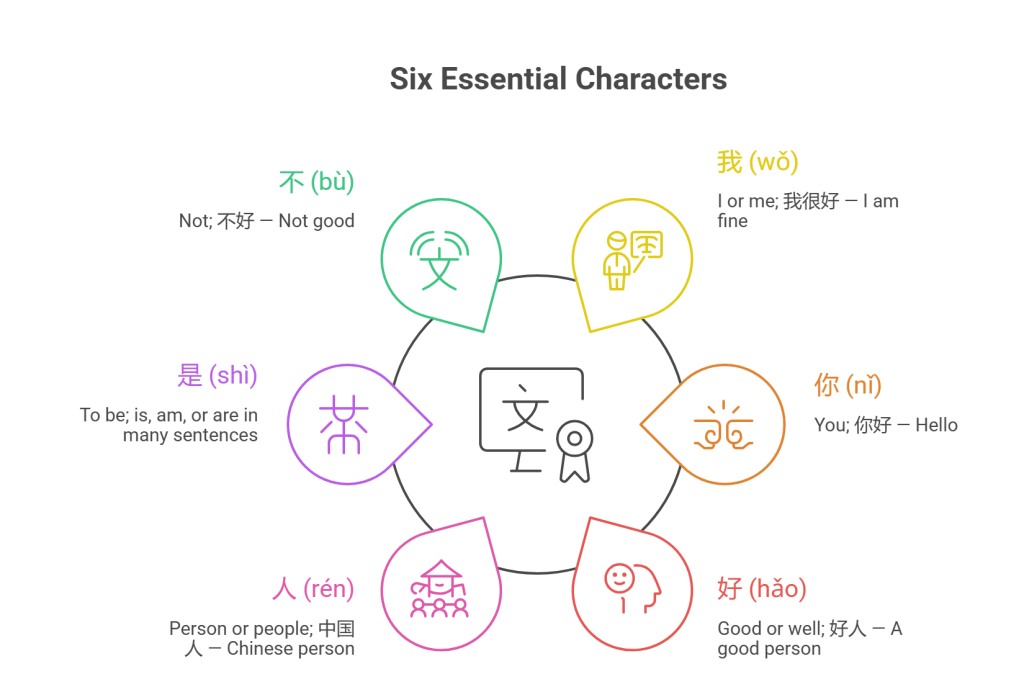
Here are six essential characters to learn first:
- 我 (wǒ) — I or me. Example: 我很好 (Wǒ hěn hǎo) — I am fine.
- 你 (nǐ) — You. Example: 你好 (Nǐ hǎo) — Hello.
- 好 (hǎo) — Good or well. Example: 好人 (hǎorén) — A good person.
- 人 (rén) — Person or people. Example: 中国人 (Zhōngguó rén) — Chinese person.
- 是 (shì) — This word means “to be” and is often used as “is”, “am”, or “are” in many sentences. For example, 我是学生 (Wǒ shì xuésheng) — I am a student.
- 不 (bù) — Not. Example: 不好 (bù hǎo) — Not good.
These characters are valuable to us because they are used in many of the words we see on a daily basis and in the beginning stages of learning to read and write. Just keep in mind that a single character can mean different things or even be pronounced differently depending on the way it is used in a sentence.
What do common Chinese characters mean in English?
Chinese characters are single units of written language that have meaning. A few of these characters can stand alone as a word; however, many of them are combined with other characters to form words. To illustrate this point, 学 (xué) refers to learning and 生 (shēng) can refer to multiple things such as life or birth. When you combine them together, you get 学生 (xuésheng), which translates to “student”.
The next list of 105 frequently used Chinese characters includes each character’s Pinyin pronunciation, its English definition, and an example of where that character can be found in daily language. Each example utilises Simplified Chinese characters as used in Mainland China.
100+ Chinese Characters: Meanings and Examples
| Chinese character | Pinyin | English meaning | Example word or phrase |
| 我 | wǒ | I; me | 我们 — we |
| 你 | nǐ | You | 你好 — hello |
| 他 | tā | He; him | 他们 — they |
| 她 | tā | She; her | 她们 — they (feminine) |
| 它 | tā | It | 它们 — they (things/animals) |
| 我们 | wǒmen | We; us | 我们好 — we are well |
| 们 | men | Plural marker for pronouns | 你们 — you all |
| 人 | rén | Person; people | 中国人 — Chinese person |
| 大 | dà | Big; large | 大人 — adult |
| 小 | xiǎo | Small; little | 小孩 — child |
| 好 | hǎo | Good; well | 好吃 — delicious |
| 是 | shì | To be; is | 不是 — is not |
| 不 | bù | Not | 不好 — not good |
| 有 | yǒu | Have; there is | 有人 — someone |
| 没 | méi | Not; have not | 没有 — do not have |
| 在 | zài | At; in; located | 在家 — at home |
| 这 | zhè | This | 这个 — this one |
| 那 | nà | That | 那里 — there |
| 哪 | nǎ | Which; where | 哪里 — where |
| 谁 | shéi | Who | 谁的 — whose |
| 什么 | shénme | What | 什么人 — what person |
| 吗 | ma | Yes/no question particle | 你好吗?— Are you well? |
| 呢 | ne | Question or topic particle | 你呢?— And you? |
| 也 | yě | Also; too | 我也去 — I am going too |
| 都 | dōu | All; both | 我们都来 — we all come |
| 很 | hěn | Very | 很好 — very good |
| 太 | tài | Too; excessively | 太好 — very good |
| 多 | duō | Many; much | 多少 — how many/much |
| 少 | shǎo | Few; little | 很少 — very few |
| 和 | hé | And; with | 我和你 — you and me |
| 但 | dàn | But | 但是 — but |
| 因 | yīn | Cause; because | 因为 — because |
| 为 | wèi/wéi | For; because of; various uses | 因为 — because |
| 来 | lái | Come | 来了 — has come |
| 去 | qù | Go | 去学校 — go to school |
| 看 | kàn | Look; watch; read | 看书 — read a book |
| 听 | tīng | Listen; hear | 听音乐 — listen to music |
| 说 | shuō | Speak; say | 说话 — speak |
| 读 | dú | Read | 读书 — read/study |
| 写 | xiě | Write | 写字 — write characters |
| 学 | xué | Learn; study | 学生 — student |
| 习 | xí | Practise; learn | 学习 — study |
| 吃 | chī | Eat | 吃饭 — eat a meal |
| 喝 | hē | Drink | 喝水 — drink water |
| 做 | zuò | Do; make | 做饭 — cook |
| 买 | mǎi | Buy | 买东西 — buy things |
| 卖 | mài | Sell | 买卖 — buying and selling |
| 要 | yào | Want; need | 我要 — I want |
| 想 | xiǎng | Think; want; miss | 想你 — miss you |
| 会 | huì | Can; know how to | 会说 — can speak |
| 能 | néng | Can; be able to | 能来 — can come |
| 可 | kě | Can; may | 可以 — may/can |
| 以 | yǐ | By; with; to | 可以 — can |
| 给 | gěi | Give; to; for | 给你 — give to you |
| 让 | ràng | Let; allow | 让我 — let me |
| 走 | zǒu | Walk; leave | 走路 — walk |
| 坐 | zuò | Sit; take transport | 坐车 — take a vehicle |
| 开 | kāi | Open; start | 开门 — open the door |
| 关 | guān | Close; turn off | 关门 — close the door |
| 回 | huí | Return; go back | 回家 — return home |
| 进 | jìn | Enter | 进去 — go inside |
| 出 | chū | Exit; come out | 出去 — go out |
| 上 | shàng | Up; on; previous | 上学 — attend school |
| 下 | xià | Down; below; next | 下课 — class ends |
| 中 | zhōng | Middle; central | 中国 — China |
| 国 | guó | Country; nation | 国家 — country |
| 家 | jiā | Home; family | 回家 — go home |
| 学校 | xuéxiào | School | 学校里 — at school |
| 老 | lǎo | Old; experienced | 老师 — teacher |
| 师 | shī | Teacher; specialist | 老师 — teacher |
| 生 | shēng | Life; birth; student in compounds | 学生 — student |
| 先 | xiān | First; earlier | 先生 — Mr.; teacher |
| 朋 | péng | Friend; companion | 朋友 — friend |
| 友 | yǒu | Friend | 朋友 — friend |
| 爸 | bà | Dad | 爸爸 — father |
| 妈 | mā | Mum | 妈妈 — mother |
| 子 | zi | Child; suffix in words | 儿子 — son |
| 女 | nǚ | Woman; female | 女儿 — daughter |
| 男 | nán | Man; male | 男生 — male student |
| 孩 | hái | Child | 孩子 — child |
| 天 | tiān | Day; sky | 今天 — today |
| 今 | jīn | Present; now | 今天 — today |
| 明 | míng | Bright; next in time | 明天 — tomorrow |
| 昨 | zuó | Yesterday | 昨天 — yesterday |
| 年 | nián | Year | 今年 — this year |
| 月 | yuè | Month; moon | 月亮 — moon |
| 日 | rì | Day; sun | 日子 — days/life |
| 时 | shí | Time; hour | 时间 — time |
| 间 | jiān | Between; interval | 时间 — time |
| 分 | fēn | Minute; part; divide | 十分 — very |
| 点 | diǎn | O’clock; point | 一点 — one o’clock/a little |
| 一 | yī | One | 一个人 — one person |
| 二 | èr | Two | 二月 — February |
| 三 | sān | Three | 三天 — three days |
| 四 | sì | Four | 四月 — April |
| 五 | wǔ | Five | 五个人 — five people |
| 六 | liù | Six | 六点 — six o’clock |
| 七 | qī | Seven | 七天 — seven days |
| 八 | bā | Eight | 八月 — August |
| 九 | jiǔ | Nine | 九点 — nine o’clock |
| 十 | shí | Ten | 十个人 — ten people |
| 百 | bǎi | Hundred | 一百 — one hundred |
| 千 | qiān | Thousand | 一千 — one thousand |
| 水 | shuǐ | Water | 水果 — fruit |
| 茶 | chá | Tea | 喝茶 — drink tea |
| 饭 | fàn | Meal; cooked rice | 米饭 — cooked rice |
| 米 | mǐ | Rice; grain | 米饭 — cooked rice |
| 菜 | cài | Vegetable; dish | 菜单 — menu |
| 水果 | shuǐguǒ | Fruit | 水果店 — fruit shop |
| 书 | shū | Book | 书店 — bookstore |
| 字 | zì | Written character; word | 汉字 — Chinese character |
| 话 | huà | Speech; words | 说话 — speak |
| 钱 | qián | Money | 多少钱 — how much money |
| 买 | mǎi | Buy | 买书 — buy a book |
| 爱 | ài | Love | 爱人 — loved one/spouse |
| 喜 | xǐ | Joy; like in compounds | 喜欢 — like |
| 欢 | huān | Joy; welcome in compounds | 欢迎 — welcome |
| 高 | gāo | High; tall | 高兴 — happy |
| 兴 | xìng | Interest; mood in compounds | 高兴 — happy |
| 忙 | máng | Busy | 很忙 — very busy |
| 累 | lèi | Tired | 很累 — very tired |
| 热 | rè | Hot | 热水 — hot water |
| 冷 | lěng | Cold | 冷水 — cold water |
| 新 | xīn | New | 新年 — New Year |
| 老 | lǎo | Old | 老人 — elderly person |
| 白 | bái | White | 白天 — daytime |
| 黑 | hēi | Black | 黑色 — black colour |
| 红 | hóng | Red | 红色 — red colour |
| 绿 | lǜ | Green | 绿色 — green colour |
Study Note: Some entries contain commonly used words or compound words to illustrate how the individual characters used in those entries function in a sentence. A single character can have multiple meanings or pronunciations; you will learn these meanings and pronunciations by studying actual words and sentences, instead of assuming each character is equal to a direct English equivalent.
How do you pronounce common Chinese characters using Pinyin?
Pinyin is a Roman-letter system that represents how people pronounce Mandarin. It will help you read words aloud and hear the different types of tones. Normally, a Pinyin spelling includes an initial consonant, a final vowel or vowel combination, and a tone. Since Chinese characters don’t have letters for the sounds of words like English does, Pinyin will be very useful as you start reading.
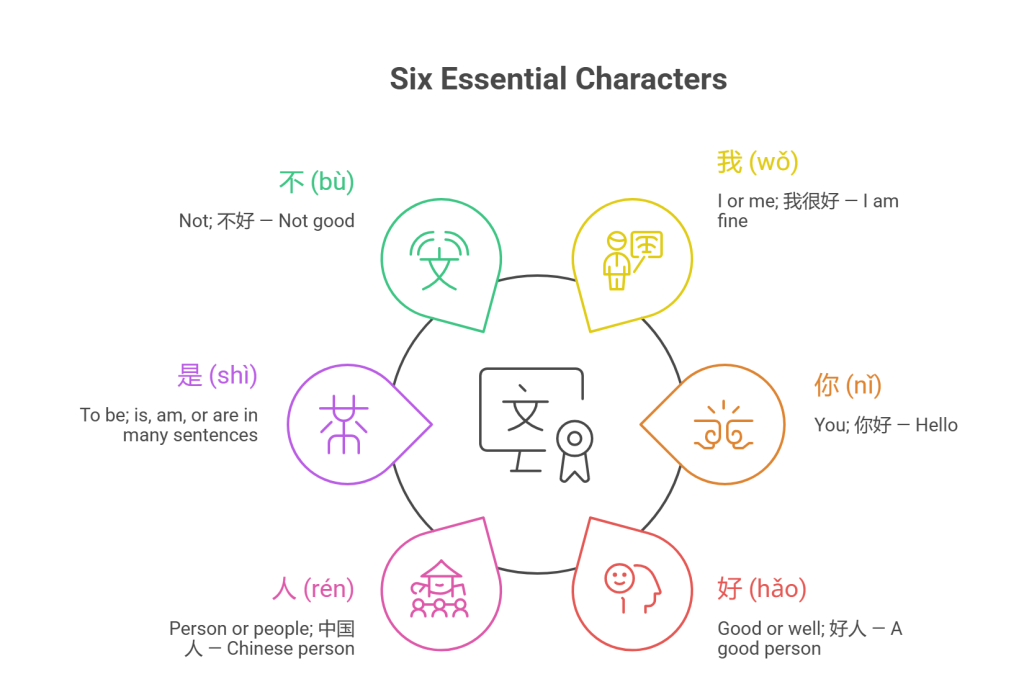
First tone (ā): High and level.
Second Tone (á): A rising tone that moves up in pitch. This is similar to the pitch movement used when asking a question in many languages.
Third Tone (ǎ): Generally lower in continuous speech; however, when it is said alone, the “dipping” contour becomes more apparent.
Fourth tone (à): A sharp falling pitch.
Neutral tone: Short and light, without a fixed tone contour of its own.
Tone is important since when you change your tone, you are changing the definition of a word. Listen to a native-speaker say a word and repeat what they said. Then use the word within an entire sentence.
Chinese Character Pronunciation and Pinyin
| Chinese Character or Word | Pinyin | English Meaning | Pronunciation Guidance |
| 我 | wǒ | I; me | Third tone; listen for the dipping contour |
| 你 | nǐ | You | Third tone |
| 好 | hǎo | Good | Third tone |
| 人 | rén | Person | The Mandarin r differs from English r |
| 是 | shì | To be | The “sh” sound is made with the tongue further back than English “sh” |
| 不 | bù | Not | Fourth tone; a falling pitch |
| 学生 | xuésheng | Student | Practise the initial x and neutral tone on the second syllable |
| 中国 | Zhōngguó | China | Practise zh and the two tones |
| 朋友 | péngyou | Friend | The second syllable is commonly neutral-toned |
| 谢谢 | xièxie | Thank you | The second syllable is commonly neutral-toned |
| 再见 | zàijiàn | Goodbye | Two fourth tones |
| 今天 | jīntiān | Today | First tone followed by first tone |
| 明天 | míngtiān | Tomorrow | Second tone followed by first tone |
| 学习 | xuéxí | Study; learn | Both syllables have second tones |
| 喜欢 | xǐhuan | Like | Third tone followed by a neutral-toned syllable in common speech |
How can you use Chinese Characters to form Simple Words?
When you can see how characters are combined with one another, it is much simpler to recall them. Do not try to memorise every single character individually, but rather focus on learning two-character words and simple phrases.
| Characters | Pinyin | Meaning |
| 你好 | nǐ hǎo | Hello |
| 谢谢 | xièxie | Thank you |
| 再见 | zàijiàn | Goodbye |
| 中国 | Zhōngguó | China |
| 中国人 | Zhōngguó rén | Chinese person |
| 学生 | xuésheng | Student |
| 老师 | lǎoshī | Teacher |
| 朋友 | péngyou | Friend |
| 家人 | jiārén | Family members |
| 今天 | jīntiān | Today |
| 明天 | míngtiān | Tomorrow |
| 吃饭 | chīfàn | Eat a meal |
| 喝水 | hē shuǐ | Drink water |
| 看书 | kàn shū | Read a book |
| 学习 | xuéxí | Study; learn |
You can learn character meanings through the use of related terms. If you learn “xué” (study) in conjunction with “student” (xué sheng), and “study” (xué xí), you will find that there is a common meaning among these words. Learning this way will help you expand your vocabulary, as well as learn about characters.
Ready to Start Learning Chinese?
Eduwatts: Best Institute for Mandarin Language Course

Eduwatts provides an introductory-level Mandarin Language Course – HSK 1 Level – that will provide you with a base in Pinyin, vocabulary, grammar, pronunciation and practical everyday communication. According to the course page, this program will include over 66 hours of instructional time; provide live online classes; provide you with access to e-learning; provide you with vocabulary flashcards; provide you with AI-powered auto-graded exercises; and issue you a certificate. This course was created specifically for individuals who have no previous knowledge of Mandarin and/or are looking to learn basic Mandarin. Before enrolling in the course, please check the most up-to-date syllabus, schedule and fee information with Eduwatts.
Course Highlights
- 66+ Hours of Training: Structured Learning to Develop Beginner-Level Mandarin Skills.
- Pinyin and Pronunciation: Learn how the sounds work, what consonants are used, what vowels are used, and the fundamentals of pronunciation.
- Grammar & Vocabulary: Create the basis for everyday words and simple sentences.
- Live online sessions: Practise through interactive instruction.
- Accessing your e-learning content: Please refer to the course website to view both the learning materials and pre-recorded resources as stated on the course website.
- Vocabulary flashcards and exercises: Reinforce retention through revision.
Beginner’s Communication skills practice includes introducing yourself, greeting others, sharing personal information and engaging in simple conversation.
Eligibility and terms can be confirmed with Eduwatts. A course completion certificate will be provided on the program page.
Talk to a Chinese Expert
Check out the Eduwatts Mandarin Language Course – HSK 1 Level for more current details on courses.
Career Opportunities after Mastering Chinese Characters
Learning Chinese characters is an essential component to developing Mandarin fluency; however, most career opportunities require more than just character recognition (i.e. speaking, listening, reading, writing and cultural understanding). Once you’ve developed these skills, you’ll find that there are many different jobs available to you.
Chinese Language Translator
Translators translate written materials (documents, websites, reports, and product information) into other languages. A translator must have a strong knowledge of characters and a good understanding of what they read in both of their working languages.
Mandarin Interpreter
The interpreter is a critical part of communication in many different types of settings, including meetings, events, business, and travel. An interpreter needs to have excellent listening skills, fast comprehension, clear and precise spoken Chinese (Mandarin), and the ability to convey the intended message to others.
International Business Coordinator
Many businesses that deal with Chinese suppliers, customers, and/or business partners would benefit from hiring individuals who have knowledge of Mandarin and are able to effectively communicate across cultures. This knowledge will assist the individual in such areas as email correspondence, discussing products, coordinating activities, and building relationships.
Customer Support Specialist
Companies that serve customers who speak Mandarin will find it helpful to hire employees with multiple languages. Employees in these roles will be able to answer customer questions about their service, provide explanations of what they offer, and assist in resolving issues.
Tourism and Hospitality Professional
Mandarin is a viable option for travel coordinators, tour companies, hotel employees and other front-line personnel who help Chinese-speaking guests.
Language Tutor or Trainer
With a good level of ability and appropriate instruction skills, students will be able to teach Mandarin to beginner levels. A strong understanding of the characters used in Mandarin can assist with teaching reading, writing, vocabulary development, and correct pronunciation.
Content Localisation Specialist
Localisation professionals are responsible for adapting digital content, products, app store listings, website content, etc, so that they can be used by various linguistic communities. As such, it is possible that some of these roles will require the professional to have a good level of Chinese reading skills as well as a strong sense of cultural awareness.
Career Tip: When you start learning Chinese characters, think of it as a milestone of achievement, not as a credential that qualifies you for a job. After you have learned 100 characters, continue to build upon your knowledge by continuing to expand your vocabulary, practice speaking with others, read short written pieces, and obtain a certification of proficiency in Chinese if that is beneficial to your professional growth.
How can I memorise Chinese characters quickly and easily?
You don’t need to memorise hundreds of Chinese characters at a single time. By practising regularly for short periods, you will begin to identify patterns and retain the material you are studying.
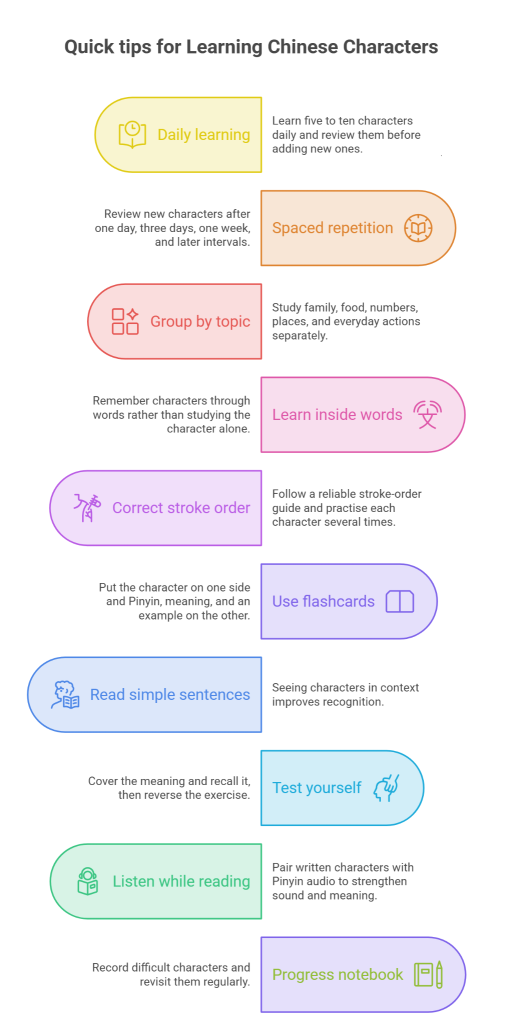
Quick Tips for Remembering Chinese Characters
Learn 5-10 characters each day: It is best to begin with a small amount of characters and review what you have learned before learning more.
Use Spaced Repetition: Review new characters after one day, three days, one week, and at later times.
Group characters by topic: Study the character groups (family, food, numbers, places, and daily activities) individually.
Learn characters within words: remember 学 from 学生 and 学习 as opposed to studying only the character.
Write with correct stroke order: Use the correct stroke order when writing each character. To help you do so, use a trusted stroke order reference and practice each character multiple times.
Use Flashcards: Write down the character on one side of a flashcard and include its Pinyin, definition, and an example sentence using the character on the other side.
Read Simple Sentences: Seeing characters in context improves recognition.
Now, try to remember what you have learned about the character’s definition and try to recognise the character based on its definition.
Listen while you read: pair written characters with Pinyin audio to make the connection between sound and meaning stronger.
Keep a Progress Notebook: Difficult characters should be recorded in this notebook, and the record should be reviewed regularly.
A Simple Seven-Day Starter Plan
| Day | Learning goal | Practice |
| Day 1 | Pronouns and people | Learn 我, 你, 他, 她, 人 |
| Day 2 | Basic descriptions | Practise 好, 大, 小, 高, 新 |
| Day 3 | Questions and negation | Learn 是, 不, 没, 谁, 什么 |
| Day 4 | Everyday actions | Practise 来, 去, 看, 听, 说 |
| Day 5 | Family and school | Learn 家, 爸, 妈, 学, 生 |
| Day 6 | Numbers and time | Practise 一, 二, 三, 天, 月 |
| Day 7 | Review and use | Write, read aloud, and use the week’s characters in simple words |
After seven days, revisit the characters you find difficult and add another group. Consistency is more effective than memorising a large list once and never reviewing it.
Conclusion
Learning Chinese Characters is simpler when you learn the most practical characters first; link each character to its Pinyin representation and meaning, and use the characters in your daily vocabulary. Begin by learning common characters, continually review them and eventually build upon your ability to read, write and speak. Students and working professionals can continue to make steady progress using a simple daily routine.
Start with five characters today, practising them in actual words. Contact us and take the first steps toward becoming confident in Speaking Mandarin!
Recommended Reads
- Master Chinese Greetings with Pronunciation & Examples
- How to Learn Chinese Language at Home: A Complete Guide
- Top 5 Mandarin Language Classes Online
- How to Learn Mandarin Language: A Complete Guide
FAQs
Ans. Some of the first characters a beginner can learn include “one,” “two,” “three,” “man/person,” “mouth,” and “big.” Learn how to write these characters using proper stroke order, and make sure that you practice writing them with the correct size relationships.er stroke order, and make sure that you practice writing them with the correct size relationships.
Ans. Commonly used characters are: 的, 一, 是, 不, 了, 我, 你, 人, 在, and 有. Although each character has a varying amount of use within different types of writing, they are all excellent starting points for someone who is just beginning to learn the language.
Ready to Start Your Learning Journey?
Join thousands of learners and build your future with expert-led courses and 100% practical training.

Pallavi Saxena
With over 15+ years of experience, I am working as an SEO Content Creator in different domains. My expertise spans a diverse range of industries, including technology, AI, Data Science, Languages, Healthcare, manufacturing, finance and more. As an SEO blog writer, I pen down words that give updated information as per industry innovation, upgradation and technological advancements. My passion lies in crafting compelling content that engages and motivates my readers.
View all articles