.webp)
Master Chinese Greetings with Pronunciation & Examples
 Pallavi SaxenaAug 19, 20261,255 views15 min read
Learning Chinese Greetings to greet one another is an essential expression. Every Chinese learner should learn greetings in Chinese in their first lesson. In addition to leading you straight into everyday conversation, these greetings will introduce you to Chinese culture. While travelling around China, studying abroad or searching for top international job roles, just saying 你好 (Nǐ hǎo) is enough to get you through the conversation.
But learning Chinese greetings is more than just memorising Chinese characters. Because Mandarin Chinese is a tonal language. And because tone changes meaning, pronunciation, pinyin, and tones are equally important! This will seem difficult initially as a beginner, but you can easily learn correct pronunciation from regular listening and speaking practice, which is much easier! Learning Greetings is an attainable and crucial first step, whether it be for a trip to China, the desire to learn Mandarin Chinese for clients or projects you are working on, or making rapid career growth with global work opportunities! In this blog, we will walk through different types of Chinese Greetings and how mastering Greeting in Chinese will boost your confidence to start communicating in the Chinese Language. Moreover, we will come across top Mandarin Language Courses from Eduwatts, a leading institute for mastering the Mandarin Langauge.
Why Are Chinese Greetings Important?

Greetings are much more than polite opening remarks. They help build rapport and convey approachability, respect, and an understanding of culture. In Mandarin, as dictated by context — based on the individual being addressed, what time of day it is and how closely related the speakers are — those who might still remember their Chinese lessons will be able to choose between 一日 and 一天 for ‘one day ‘.
For instance, 你好 (Nǐhǎo) is a casual and polite greeting, while 您好 (Nǐnhǎo) denotes respect in addressing older people or more formal situations. In the same way, 早上好 (Zǎoshang hǎo) means “Good Morning”, and 晚上好 (Wǎnshàng hǎo) means, “Good Evening”.
And that is why, in particular, it is important to learn a few greetings with correct pronunciation due to the tones of Mandarin. If a learner is unable to practice the tones for what they understand from the written phrase, then it is possible that they may not be easily understood. So the winning method of learning Chinese must include each of its characters, Pinyin, listening, pronunciation and practical usability.
How to Greet in Chinese with Pronunciation?
- Start with 你好 (Nǐ hǎo)
One of the most recognised Mandarin Greetings is 你好 (Nǐ hǎo), which means “Hello”. Pinyin pronunciation that can be used to relate Chinese characters to spoken Mandarin, which is easier for beginners. Practice the tones carefully; do not say this phrase like an English Sentence.
- Learn 您好 (Nín hǎo) for Respect
Any Chinese learner knows that 您好 (Nín hǎo) is the way to go when you want to be respectful in Chinese. Nín hǎo (您好) is a polite version of hello, especially if you are speaking formally.
When you are talking to elders, teachers, senior professionals or respected people, it can be used. The use of polite language is a sign that you are aware of social etiquette and will help others judge your character.
- Match Greetings with the Time of Day!
For “Good Morning”, use 早上好 (Zǎoshang hǎo) and for “Good evening”, use 晚上好 (Wǎnshàng hǎo). Time-based greetings have an immediate effect on the authenticity of your conversations and will help reinforce the fact that you are using Mandarin in context. Say them out loud at the same time of day to reinforce your memory and pronunciation.
- Pay Attention to Mandarin Tones
Mandarin employs four tones (+1 for a neutral tone) in contrast with some other languages, and tone is part of the pronunciation that can change the meaning of a syllable. When practising saying how are you, please listen to the natives say it and imitate their pitch movement instead of just relying on English phonetics.
- Combine Words with Natural Body Language
Record yourself to find out the pronunciation differences and become better, little by little. This will not affect the way you say it, only your body language and facial expressions. A pleasant expression, proper eye contact and comportment add value to your verbal greeting. But in professional or formal settings, it is very important to appear calm and respectful.
A combination of these two aspects can make your greeting more natural and culturally appropriate.
Basic Greetings in Chinese
- 你好 (Nǐ hǎo) – Hello
Mandarin greeting for beginners is 你好ni hao. It literally sounds good, but its natural English equivalent is hello or hi. It can be utilised in countless regular circumstances.
- Hello (Nín hǎo) Respected 先生,
There is a more respectful version, which is 您好. The pronoun 您 (nín) implies formality. It is handy for greeting elders, teachers, seniors at work, clients, or people with whom one wants to keep formal politeness.
- Good Morning: 早上好 (Zǎoshang hǎo)
This greeting means “Good Morning.” It is more suitable in the morning when talking to colleagues and friends.
4. Good Afternoon – 下午好 (Xiàwǔ hǎo)
下午好 means “Good afternoon.” It is a simple time-of-day greeting that can be used in formal and semi-formal contexts, when you would like to recognise what time it is.
5. Good Evening – 晚上好 (Wǎnshàng hǎo)
This is how you say good evening: 晚上好 (wǎnshàng hǎo). It is helpful when you are having an encounter with someone later in the day, or attending any nighttime occasion.
Common Greetings in Chinese
- 最近怎么样?(Zuìjìn zěnmeyàng?) – How Have You Been Recently?
This expression asks about the recent state of a person. This is helpful when you know the person already and just want to go beyond a simple hello with him/her.
- Long Time No See, in Chinese: 好久不见 (Hǎojiǔ bú jiàn)
This well-known phrase is used when meeting someone after a long time. It is warm, conversational, casual, and one you would use around your friends, people you already know.
- 你吃饭了吗?(Nǐ chīfàn le ma?) – Have You Eaten?
This phrase carries cultural context and can even be interpreted as an affectionate inquiry instead of a serious request asking if one has eaten. The interpretation depends on the context.
- 最近忙吗?(Zuìjìn máng ma?) – Free Lately?
This is a handy conversational greeting for when you are reuniting with someone. This would facilitate conversations regarding work, study, family, travel or workday activities.
- Huítóu jiàn(回头见) – See you then
And 回头见 (huí tóu jiàn): See you soon or as a casual farewell. If you think you’ve met the person again at least once, it’s helpful in everyday situations.
Formal Greetings in Chinese

Learning how to speak formal Mandarin properly involves considerations around respect, proper business etiquette and context. Use the following expressions, which you may find useful in your workplace and official communication.
1. 您好 (Nín hǎo) – Hello
This is the most common respect-filled greeting you can get in Mandarin. Professors can use it when he speaks with seniors, customers, teachers, business partners, or older people.
2. 各位好 (Gèwèi hǎo) – Hello, Everyone
Note that 各位好 is favourable when greeting someone in a group. You hear this in presentations, meetings, events, classes — wherever the speaker needs to greet many people at the same time.
3. 欢迎您 (Huānyíng nín) – Welcome
It is composed of 幸 (huānyíng), which means “welcome”, and the respectful pronoun ní. When welcoming guests, clients, visitors or other professional contacts, it comes into play.
4. 很高兴认识您 (Hěn gāoxìng rènshi nín) – Pleased to Meet You
Nice to meet you = わたしはおまえにあえてうれしい. This is especially useful for introductions, networking events, work-related meetings and more formal social settings.
5. 初めまして、どうぞよろしくお願い致します (Hajimemashite, douzo yoroshiku onegaishimasu) — Nice to meet you; Please be good with me
This is a more formal way of greeting someone, and it indicates humility and respect when meeting that person. It can be used in a more professional or culturally formal setting.
Informal Greetings in Chinese

- 嗨 (Hāi) – Hi
嗨 (hāi) — A very laid-back “Hello,” it borrows from the English language and is already widely used in casual conversations. Friends, peers and casual social interactions are its best use case.
- 哈喽 (Hā lóu) – Hello
Another casual expression borrowed from English “Hello” is, 哈喽. Its casual and conversational, usually more appropriate for informal discussions than formal international business.
- Long Time No See / 好久不见 (Hǎojiǔ bú jiàn)
It is a natural way to re-establish contact with friends after some time apart. Getting back to work, studies, familiy, travel or daily life.
- 最近怎么样?(Zuìjìn zěnmeyàng?) – How Have You Been?
This phrase may be a low-key conversation starter with friends and people you know. This expression is versatile and allows the speaker to show sincere interest in what the other person has been up to lately.
- See You Later (回头见 means huítóu jiàn)
This is also a casual goodbye that you can use when you know you will see the person again. You can hear that it is friendly and casual instead of overly formal.
Different Kinds of Chinese Greetings
| Korean Greetings | Translation in English | Meaning | Example |
| 你好 (Nǐ hǎo) | Hello | Standard polite greeting | 你好,很高兴认识你。 |
| 您好 (Nín hǎo) | Hello | Respectful greeting | 您好,王老师。 |
| 早上好 (Zǎoshang hǎo) | Good morning | Morning greeting | 早上好,今天好吗? |
| 下午好 (Xiàwǔ hǎo) | Good afternoon | Afternoon greeting | 下午好,欢迎来到公司。 |
| 晚上好 (Wǎnshàng hǎo) | Good evening | Evening greeting | 晚上好,各位。 |
| 好久不见 (Hǎojiǔ bú jiàn) | Long time no see | Greeting someone after a long time | 好久不见,你最近好吗? |
| 最近怎么样?(Zuìjìn zěnme yàng?) | How have you been? | Asking about someone’s recent life | 最近怎么样? |
| 你吃饭了吗?(Nǐ chīfàn le ma?) | Have you eaten? | Friendly conversational greeting | 你好,你吃饭了吗? |
| 各位好 (Gèwèi hǎo) | Hello, everyone | Greeting a group | 各位好,欢迎参加会议。 |
| 欢迎您 (Huānyíng nín) | Welcome | Respectfully welcoming someone | 欢迎您来到我们的公司。 |
| 很高兴认识您 (Hěn gāoxìng rènshi nín) | Pleased to meet you | Formal introduction | 很高兴认识您。 |
| 嗨 (Hāi) | Hi | Casual greeting | 嗨,最近怎么样? |
| 哈喽 (Hā lóu) | Hello | Casual, friendly greeting | 哈喽,好久不见! |
| 回头见 (Huítóu jiàn) | See you later | Casual farewell | 回头见,明天聊。 |
| 再见 (Zàijiàn) | Goodbye | General farewell | 再见,明天见。 |
Understanding Pinyin and Chinese Pronunciation
Among the many aspects of Mandarin Chinese, pronunciation is easily among the most critical. Pinyin is the Romanisation system of Mandarin pronunciation using Latin letters. Providing learners with a practical connection between Chinese characters and spoken language.
Mandarin sounds like x, q, zh, ch and sh are often confused with English letters that look similar but have different behaviours: z, j, r. Tones are equally important. In natural connected speech, two consecutive third tones are pronounced differently (hence why learners need to listen to natural recordings and practise complete phrases as opposed to individual syllables).
5 Steps of a Great Learning Habit
Listen-repeat-record-compare-and go again!
Focusing on specific pronunciation for just ten minutes every day is much better than a long yet infrequent session working on vocabulary.
Eduwatts: No.1 Institute for Chinese Language Certification Courses
Eduwatts is the No. 1 institute offering Online Mandarin Chinese language courses. It is a professional training platform with live instructor-led courses, practical applications, and expert mentorship. The institute is known for high-quality Online Training in Mandarin Language from HSK 1 to HSK 6 level, including postgraduate diploma and master’s level courses.
Eduwatts offers HSK 1 → 66+ hours of live training, e-learning, AI exercises, and tons of other academic content, including vocabulary, reading flashcards, and internship experience as well, that leads towards your certification. You can advance your Mandarin language learning through HSK Level 1 to HSK Level 6. Start your student journey from Chinese greetings to speaking Mandarin professionally.
Why is Eduwatts the Best Online Chinese Language Learning Platform?
Structured HSK Learning Path
A structured HSK Learning Path builds a foundation first before stepping toward advanced communication.
- Live Interactive Training
Courses are interactive, and trainees are actively trained in real-time rather than watching recorded lessons. It creates opportunities for learners to practice communication and receive guidance when developing their Mandarin skills.
- Digital Learning Resources
Mandarin classes offered by Eduwatts include digital resources such as 24/7 access to e-learning, AI-driven auto-graded exercises, and flashcards for vocabulary.
- Practical and Career-Oriented Learning
In the case of Mandarin, these courses focus on practical communication goals. The higher levels emphasise a more professional, academic and complex type of communication.
- Progressive Advanced Learning
Learners will be able to learn from HSK 1 for beginners all the way up to HSK 6 advanced without needing to change the overall learning pathway. The lengths of courses also grow as the ability increases, starting from 66+ hours for HSK 1 and ending with over 218 hours at level HSK 6.
Why Choose Eduwatts?
| Top Features | Descriptions | Top Courses | Benefits |
| HSK-based learning | Structured Mandarin learning from beginner to advanced | HSK 1–HSK 6 | Progressive skill development |
| Live training | Interactive, real-time instructor-led sessions | All HSK levels | Guided learning and communication practice |
| E-learning access | Online learning resources available through the learning portal | HSK 1–HSK 6 | Flexible revision |
| AI-powered exercises | Auto-graded practice activities | HSK courses | Additional practice and feedback |
| Vocabulary flashcards | Digital vocabulary practice | HSK 1–HSK 6 | Vocabulary retention |
| Practical communication | Focus on everyday, academic and professional communication | HSK 1–HSK 6 | Real-world language application |
| Career support resources | Premium job portal and internship experience are listed among course inclusions | Selected Mandarin courses | Career-oriented learning support |
| Certification | Course pages list professional certification | HSK 1–HSK 6 | Evidence of course completion |
| Advanced proficiency | Higher levels develop sophisticated communication skills | HSK 5–HSK 6 | Advanced Mandarin capability |
Eduwatts specifically lists live training, e-learning access, AI-powered exercises, vocabulary flashcards, internship experience, job-portal access, and professional certification among the HSK course inclusions.
Top Mandarin Chinese Language Courses
- Mandarin Language Course – HSK1 Level
- Mandarin Language Course – HSK2 Level
- Mandarin Language Course – HSK3 Level
- Mandarin Language Course – HSK4 Level
- Mandarin Language Course – HSK5 Level
- Mandarin Language Course – HSK6 Level
Popular Chinese Language Courses At Eduwatts
| Chinese Language Course Name | Chinese Language Levels | Ideal For | Key Skills | Course Duration | Course Fees |
| Mandarin Language Course – HSK 1 | Beginner | Beginners, students, professionals | Basic vocabulary, pronunciation, greetings, simple conversations | 66+ Hours | ₹10,500* |
| Mandarin Language Course – HSK 2 | Elementary | HSK 1 learners, students, professionals | Pinyin, everyday vocabulary, greetings, basic grammar and communication | 70+ Hours | ₹11,500* |
| Mandarin Language Course – HSK 3 | Intermediate | HSK 2 learners, HSK 3 candidates | Speaking, listening, reading, writing, grammar and cultural understanding | 88+ Hours | ₹15,500* |
| Mandarin Language Course – HSK 4 | Intermediate/Upper Intermediate | HSK 3 learners and professionals | Presentations, broader vocabulary, reading, communication and professional Mandarin | 118+ Hours | ₹18,500* |
| Mandarin Language Course – HSK 5 | Advanced | HSK 4 learners, professionals, researchers | Advanced grammar, vocabulary, reading, writing and complex communication | 190+ Hours | ₹27,500* |
| Mandarin Language Course – HSK 6 | Advanced/Highest Level | HSK 5 learners, professionals and advanced students | Advanced communication, academic reading, writing, vocabulary and HSK preparation | 218+ Hours | ₹27,500* |
*Fees shown are the discounted fees currently displayed on the respective Eduwatts course pages and may change.
The course durations also increase as the proficiency level advances, from 66+ hours at HSK 1 to 218+ hours at HSK 6. This reflects the broader vocabulary, grammar, communication, reading, writing, and comprehension requirements at higher levels.
Learning Benefits of Chinese Greetings
- Builds Immediate Communication Skills
- Improves Pronunciation
- Strengthens Cultural Awareness
- Increases Confidence
- Creates a Strong Language Foundation
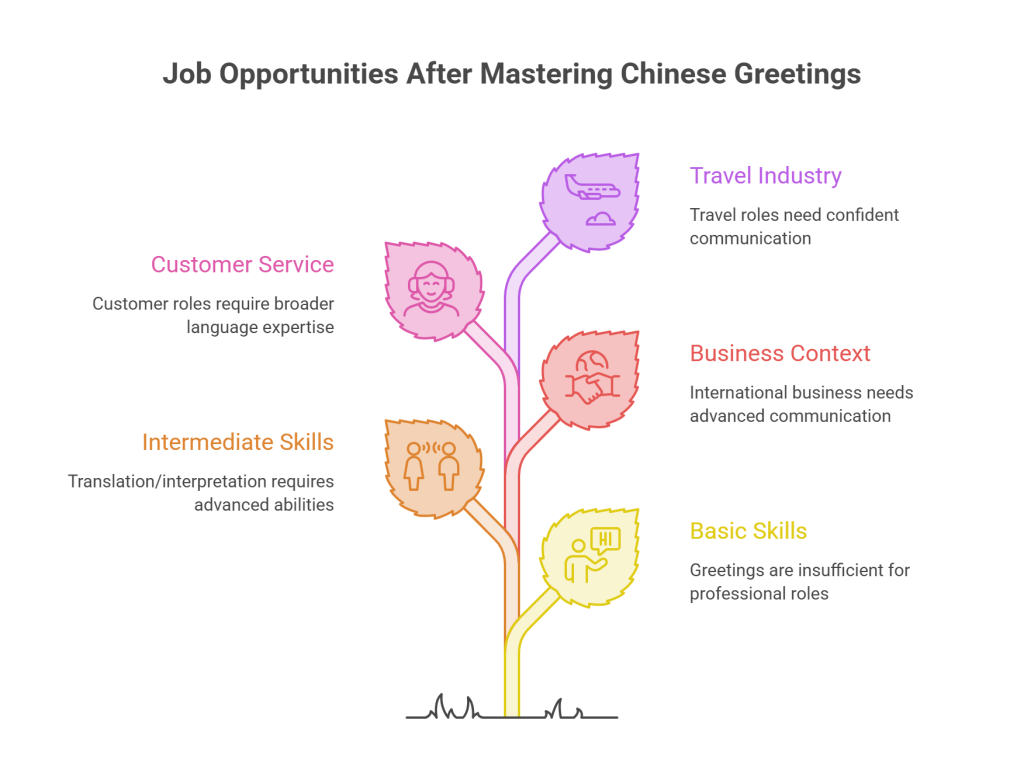
Top Job Roles After Mastering Chinese Greetings
- Chinese Language Trainer
- Chinese Translator or Interpreter
- International Business Executive
- Customer Relationship Executive
- Travel and Hospitality Professional
Conclusion
Learning Chinese greetings with pronunciation—a seemingly minor goal—creates a mighty starting point for every Mandarin learner. Greeting other people with expressions like 你好 (Nǐ hǎo), 您好 (Nín hǎo), 早上好 (Zǎoshang hǎo), 晚上好 (Wǎnshàng hǎo) and 好久不见 (Hǎojiǔ bú jiàn) easily helps learners start a conversation, catch up with others and be more confident in life. The key takeaway is that there is more to learning Chinese greetings than implanting a translation into your brain. All of them are responsible for communication: pronunciation (Pinyin), tones, context and cultural etiquette. A natural and respectful-sounding greeting can help make a good first impression and show your actual interest in the Chinese language and culture.
As an absolute beginner, stick to the most frequently used expressions and come back to them over and over again. You listen, read how it is pronounced, repeat the pronunciation yourself and record your voice also under/over/into realistic conversation. When you feel comfortable, progress from greetings to introductions, questions to small talk, professional vocab, reading & writing.
Eduwatts is a structured Mandarin pathway to study from HSK 1 — HSK 6 that lists all course pages from their live training, e-learning resources, vocabulary flashcards, AI Exercises and +Certification. (Eduwatts). Be it travel, education, culture, international business or career aspirations, Chinese greetings can be the first step in your journey towards real communication. Begin with 你好, say it loudly and boldly and allow each greeting following to be another learning experience.
FAQs
Ans. 你好 (Nǐ hǎo) is probably the most common Mandarin greeting and literally means “Hello.” It is not only helpful in daily conversations, introductions, and classrooms but also useful for travel situations, everyday life or casual professional use.
Ans. Hello is Nǐ hǎo in Pinyin: 你好. As such, both syllables are usually marked with third tones (but this is subject to natural phonetic alteration in connected speech). Repetition of native-speaker audio develops tones in learners.
Ans. For example. This is the meaning of 你好 (Nín hǎo), which is how we say “Hello” in a respectful way in Mandarin. When is it right: You use this while talking to the higher-order people like senior colleagues, teachers, customers, and even when speaking to an elder person or a respectful one.
Ans. Tones matter because Mandarin uses different pitch patterns in order to differentiate the meanings of syllables. If you learn the right tones from the very start, your pronunciation, listening comprehension and intelligibility will be better in Mandarin conversations that take place in real-life contexts with real people; they are much less likely to be a source of fear.
Ans. Probably, every learner memorises a few basic greetings within two or three study sessions. But practising by listening to the audio and repeating it naturally takes time. Daily practice, which could be just 10 minutes a day, will, over the course of time, start to solidify and build accuracy, confidence and conversational fluency.
Ready to Start Your Learning Journey?
Join thousands of learners and build your future with expert-led courses and 100% practical training.

Pallavi Saxena
With over 15+ years of experience, I am working as an SEO Content Creator in different domains. My expertise spans a diverse range of industries, including technology, AI, Data Science, Languages, Healthcare, manufacturing, finance and more. As an SEO blog writer, I pen down words that give updated information as per industry innovation, upgradation and technological advancements. My passion lies in crafting compelling content that engages and motivates my readers.
View all articles





Recent Comments (27)
Overall, the article strikes a good balance between learning a language and cultural etiquette. And both play an equal role in speaking a foreign language.
I had no idea there were greetings for every occasion and relationship. And this article explains those nuances pretty well.
The practical examples are great. When you study through how greetings are carried out, then areas of them in your thoughts, once they turn into something that fit within a dialogue circle.
The thing I liked about this article is the coverage of cultural understanding along with language learning. This makes it ever so much more interesting than just reading a list of vocabulary words.
This is a really valuable feature as cultural notes. Without knowledge of the context behind greetings, learners do not communicate naturally.
I have a new language, Mandarin, and this article provided me with several additional phrases to try. The examples clarify when each greeting is appropriate.
I came across the part of you: “Have you eaten? particularly interesting. The fact that it highlights as much culture as it does language illustrates how greetings reflect maybe every bit as much.
This is probably the most straightforward rundown on how to greet in Chinese that I have seen. The Pronunciation tips will be useful for beginners.
The examples are down to earth, memorable and easy to remember. I am already imagining using some of these greeting when doing my chitchat or Mandarin practice.
The formal and informal greetings were a good explanation. You should know when to use « Nín Hǎo » versus « Nǐ Hǎo » (in order to make a good impression).
A highly helpful guide for starters. As previously mentioned, “Ni Hao” is not the only greeting used in Chinese and I had never encountered so many other greetings before.
This article made learning Chinese greetings feel much less intimidating. I especially liked the pronunciation guidance along with the examples.
Informative and interesting post. This definitely helped me understand Chinese greetings better.
Loved the way the greetings are explained. A very useful learning resource.
Nice article! The explanations are straightforward and easy to understand.
I found this guide really helpful, especially for beginners learning Chinese.
Very useful information presented in a simple way. Keep sharing such helpful articles!
The article is easy to follow and gives a nice introduction to common Chinese greetings.
Great resource for anyone interested in Chinese language and culture.
Well-written and informative post. I learned something new today!
Thanks for sharing this useful guide. It makes Chinese greetings easier to remember.
Very interesting article. I especially liked the practical examples provided here.
Excellent content! Simple, clear, and useful information about Chinese greetings.
I really enjoyed reading this article. The examples make learning much easier.
This is a very informative post for beginners who want to learn Chinese greetings.
Great explanation and very easy to understand. Thanks for sharing!
Really helpful article! I learned several useful Chinese greetings from this guide.