.webp)
Medical Coding Course: Details, Duration, Fees, Eligibility, Syllabus & Jobs (2026 Guide)
 Nidhi GuptaAug 28, 20261,096 views15 min read
A Medical Coding Course is one of the quickest ways of entering India’s rapidly growing healthcare BPO and healthcare IT industry without spending several years studying in a medical school. If you have been on the lookout for a lucrative, non-clinical healthcare career option that does not require a medical qualification but offers excellent salary prospects and work-from-home opportunities, this article is your comprehensive guide. The article outlines all the important details about the course such as its curriculum, duration, eligibility criteria, tuition fees, and possible employment options with expected salary ranges.
This article will prove to be particularly useful if you are a science graduate, a student of life sciences, a nurse who wishes to switch to a non-clinical job role, or an IT professional with an interest in healthcare information technology.
What Is a Medical Coding Course?
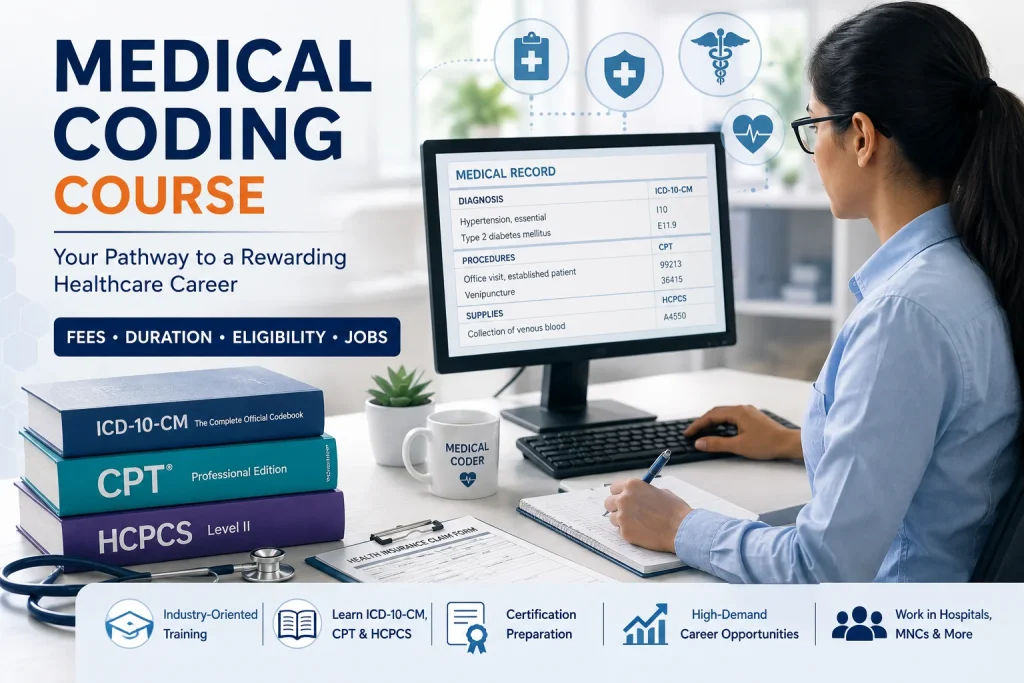
The answer of what is medical coding includes – The conversion of a physician’s diagnosis, treatment, and medical procedure to alphanumeric codes forms the process of medical coding. The alphanumeric codes, primarily ICD-10-CM, CPT, and HCPCS Level II codes, help hospitals, insurance companies, and healthcare providers to claim and bill their patients’ medical insurance as well as keep records of patient information.
Medical Coding Training is designed to teach you how to decode clinical information and assign appropriate codes effectively and efficiently. This course combines your healthcare knowledge and administrative skills precisely; that’s why it has become the most in-demand career choice in the country.
While a medical degree demands years of education and training, Medical Coding Training requires just a few months to be completed, and you can begin working in hospitals, insurance companies, and healthcare BPOs soon after that.
Why Choose a Medical Coding Training Course in 2026?
Patient information is being digitized in healthcare institutions around the world at an unprecedented rate, making precise coding absolutely crucial for the reimbursement of hospitals and the processing of claims. A few reasons why medical coding remains a popular profession:
- High demand, non-clinical position — you can work in the field of healthcare but without directly attending to patients.
- Shorter training time than all clinical degrees combined.
- International scope of activities — coders from India have a high demand in the US because of the cost efficiency and highly-skilled workforce.
- Flexibility — a lot of medical coding positions can be performed remotely, particularly those that work with American customers.
- Recession-proof — payment and claims processing of healthcare facilities will continue despite economic downturns.
- Certification track is clear — internationally recognized certificates such as CPC or CCS will make your CV shine.
Medical Coding Course Eligibility
- Among the very first things that candidates look out for is their eligibility. And the great thing is that eligibility conditions for taking up a Medical Coding Training Course are relatively easy as compared to other healthcare professions.
- Eligibility conditions:
- Completion of 10+2 (higher secondary), preferably with a science stream, generally serves as the minimum eligibility condition at many institutes.
- Possession of a degree in life sciences, para-medical sciences, nursing, pharmacy or other healthcare-related subject is highly desired and, at many institutes, mandatory to pursue the certification program.
- People who have obtained an MBBS, BDS, BHMS, B.Pharm, B.Sc (Life Sciences), or Nursing degree have an upper hand because of their knowledge of human anatomy and medical terminologies.
- Non-science students with an inclination towards healthcare management are also considered suitable candidates by many training institutions, although they will have to exert some extra effort on anatomical and terminological modules.
- There is no upper age bar for this course as well, thereby making this course an ideal choice for professionals seeking a career change.
- A basic proficiency in using the computer and knowledge of English medical terminologies is required, since all reference material and examinations are conducted in the English language.
In case of any confusion regarding whether your academic qualification suits this course or not, most institutions provide a free eligibility test or consultation over the phone.
Medical Coding Course Duration
The Duration of Medical Coding Training Course depends on whether you opt for certificate course, diploma course, or an online self-paced course. Below is a realistic timeframe for each format of Medical Coding Training course:
| Course Type | Typical Duration | Best For |
| Short Certificate Course | 3–4 months | Quick entry-level training, working professionals |
| Standard Certificate/Diploma | 6 months | Most common path, includes CPC/CCS exam prep |
| Advanced/Associate Diploma | 6–12 months | In-depth training with internship or practicum |
| Online Self-Paced Course | Flexible (weeks to months) | People having a job/studies along with training |
| In-Person Classroom Training | 3–6 months (fixed schedule) | People preferring instructor led sessions |
The majority of people in India join a 6 month to 1-year diploma/certificate program where they get prepared for AAPC/AHIMA Certification exam and a Junior Coder position in the industry. Online courses offer more flexibility to the trainees, whereas classroom in-person trainings are fixed duration trainings with hands-on lab sessions.
Medical Coding Course Syllabus
The syllabus for the Medical Coding Training course is intended to develop clinical knowledge as well as coding skills. Although the specific curriculum might vary from one institution to another, here are some of the common topics covered:
1. Human Anatomy and Physiology
Knowledge of body systems (like the cardiovascular system, respiratory system, musculoskeletal system, nervous system, digestive system, etc.) is important to be able to code diagnoses and procedures.
2. Medical Terminology
Study of prefixes, suffixes, root words, and common clinical abbreviations as used in doctor’s documentation and hospital reports.
3. Introduction to Medical Coding
Definition of medical coding and its importance to the health care revenue cycle.
4. ICD-10-CM Coding (Diagnostic Coding)
Thorough training on accurate coding of diagnoses, including code sets specific to certain chapters, such as infectious diseases, injuries, tumors, and maternity.
5. CPT Coding (Procedural Coding)
Training in Current Procedural Terminology codes that include medical, surgical, and diagnostic procedures – specifically E/M codes, which are notoriously difficult and one of the most highly tested coding sections.
6. HCPCS Level II Codes
Coding of medical equipment, supplies, drugs, and procedures that fall outside of CPT codes – usually applied in outpatient billing.
7. Basic Reimbursement and Insurance Information
Knowledge about how the process of insurance claims works, insurance guidelines, billing cycles in medicine, and HIPAA compliance requirements.
8. Compliance, Audits, and Documentation Standards
Training in coding ethics, audit pitfalls, and how to improve documentation to avoid claim denials.
9. Hands-on Practical Case Studies & Chart Coding
Hands-on training in coding actual (de-identified) medical charts and notes made by physicians – here is where the theoretical knowledge is translated into practical skills.
10. Mock Exams & Test Preparation for Certification
The vast majority of respectable programs always conclude with practice exams modeled after the CPC certification test offered by AAPC or the CCA/CCS certification test from AHIMA, since employers favor certified specialists.
Course curriculum that places more emphasis on the practical aspect of chart coding rather than the theoretical one is generally a good indicator of program’s quality. While researching, always inquire at any shortlisted institute about the time split between practical and theoretical training.
Medical Coding Certifications
A certificate can help a job applicant build a strong portfolio, especially when seeking a good coding job.
Examples of recognised certifications are:
AAPC CPC
The CPC (Certified Professional Coder) certificate gives emphasis to professional-service coding. According to AAPC, the CPC exam tests knowledge about CPT, HCPCS Level II, ICD-10-CM, documentation, compliance, and physician services.
AHIMA CCA
The CCA (Certified Coding Associate) certification is intended for new coding professionals. As per AHIMA, it is an early-career certification and a high school diploma is the minimum requirement to sit for the exam.
AHIMA CCS
The CCS (Certified Coding Specialist) certification is intended for experienced coding professionals. According to AHIMA, the prerequisite for CCS exam is education or coding experience in the field.
The right certification depends on your education, experience, career goal, and target employer.
Medical Coding Course Fees & Career Scope
Fees for Medical Coding Training Course in India are dependent on the quality of the institute, the structure of the course, the place and even whether the certification exam fee is covered in the total cost. Below is the fee range as per the current year 2026:
| Course Category | Approximate Fees (INR) |
| Basic/Short-Term Courses (3–4 months) | ₹25,000 – ₹60,000 |
| Standard Professional Courses (6 months) | ₹60,000 – ₹1,20,000 |
| Certification-Oriented Programs (with exam fee included) | ₹1,00,000 – ₹2,50,000 |
| AAPC CPC Exam Fee (standalone, non-member) | Approx. USD 399 (~₹33,000) |
Points to keep in mind while considering fees:
- Online courses generally cost less than traditional classroom teaching courses.
- The courses in which the exam fee for CPC or CCS is already paid as part of course fee are generally costlier but help you save from paying separately later.
- Make sure whether the study material, practice charts, mock test papers, and placement facility is included in the total fee.
- At least 2-3 institutes have to be compared before choosing one since there could be a difference of tens of thousands of rupees in fees for the exact syllabus.
Career Scope
There are a number of reasons why opportunities for certified medical coders keep growing:
- Medical facilities all around the world have started implementing computerization of their documents and outsourcing the billing/medical coding services.
- India is among the best outsourcing locations for the US healthcare because of the high English proficiency and qualified staff.
- Developed countries face aging of their population which results in higher number of medical claims and procedures, and therefore a need for accurate coding.
- Highly complicated regulatory requirements that require frequent updates of such classifications as ICD-10, CPT and others will ensure constant demand for qualified and certified medical coders.
Summarizing, this occupation is considered quite recession-proof one since it belongs to the field of healthcare.
Is Medical Coding a Good Career Choice?
Yes, medical coding can make an excellent career choice for people who love working in the healthcare sector, documenting, researching, and detail-oriented tasks.
Medical coding is especially ideal for people who wish to work in the healthcare sector but do not necessarily want to go into the clinical side of things.
The only downside to medical coding is that it involves a lot of accuracy and continuous learning. Holding a certificate does not automatically assure you of employment.
According to AHIMA, credentials can aid in proving competence and dedication towards continued education, while their coding programs have been structured with certification in mind.
Medical Coding Training Course: Career Path
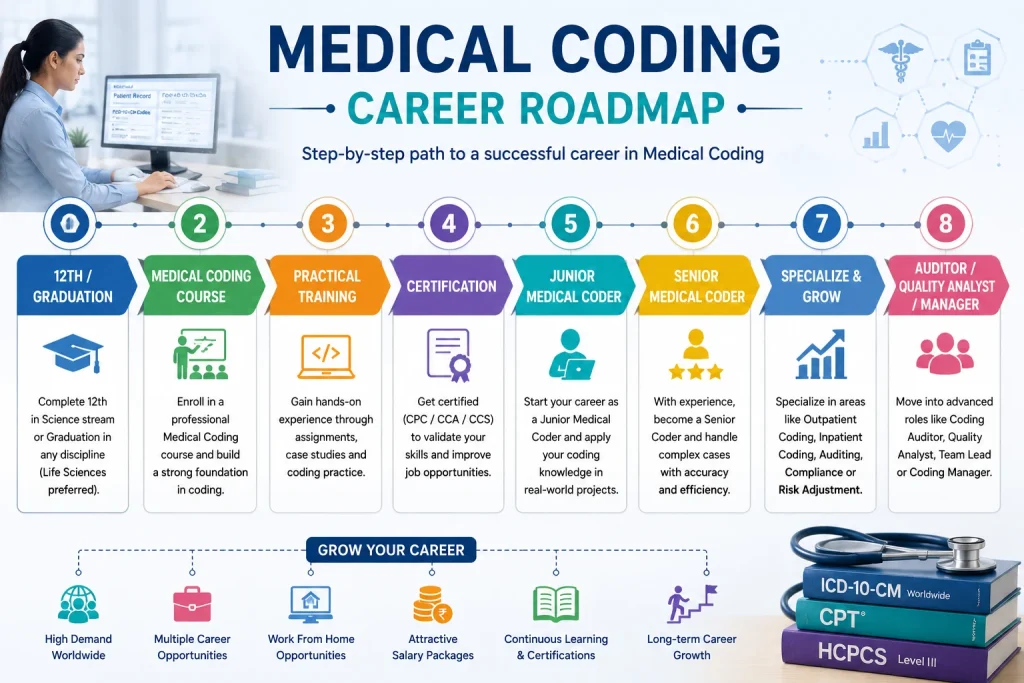
Here is a brief description of the career path:
Class 12 or Graduation → Medical Coding Training Course → Coding Practice → Certification → Entry Level Coding Job → Specialization → Advanced Coder, Auditor, or Quality Analyst
It is not necessary for students to learn all specialisations right from the start.
Skills You Need for Medical Coding Careers
For an effective medical coding career, more is required than just the ability to memorise codes.
These are some skills that you should have:
- Medical Terminology: You need to know the medical terminology accurately.
- Attention to detail: One minor difference in the documentation could lead to a different choice of code.
- Analysis: The coder will analyse the medical and coding guidelines.
- Computer proficiency: Medical coding requires the use of computer applications.
- English proficiency: Coding is done using many documents written in English terminology.
- Research skills: A coder will refer to a lot of medical coding references while doing the job.
- Time management: Coders have to work efficiently and accurately to meet professional standards.
Medical Coding Careers: Job Roles & Salaries
After completing a Medical Coding Training Course, you will have access to various career opportunities in medical coding. These include:
- Medical Coder / Junior Coder – entry-level position coding ICD-10, CPT, and HCPCS codes.
- Certified Professional Coder (CPC) – credentialed coder responsible for outpatient and physician office coding.
- Medical Billing Specialist – position that deals with billing and reimbursement aspect of the revenue cycle.
- Coding Auditor – job that involves auditing of the codes and requires coding experience.
- Clinical Documentation Improvement (CDI) Specialist – collaborates with doctors and ensures that documentation is done properly.
- Coding Team Lead / Coding Manager – supervisory positions for coders with a few years of experience.
- Risk Adjustment Coder / HCC Coder – specialized field and well-paid niche in medical coding.
Places where Medical Coders Work:
- Hospitals and multispeciality clinics
- Health insurance companies (TPAs)
- BPOs in Healthcare and Revenue Cycle Management (RCM) firms
- Work from home jobs for US based healthcare organizations
Salary Expectations
| Experience Level | Approximate Salary (INR/year) |
| Fresher / Entry-Level | ₹2.5 – ₹4.5 LPA |
| Certified Coder (1–3 years) | ₹4 – ₹6 LPA |
| Experienced / Specialized Coder (4+ years) | ₹6 – ₹10 LPA |
| Coding Auditor / Team Lead | ₹8 – ₹15 LPA |
Certifications help in getting a higher salary as certified coders (CPC / CCS) always earn better than non-certified coders with equivalent experience, especially those who code for international clients or specialize in areas such as risk adjustment coding.
How to Choose the Right Medical Coding Course?
Selecting an appropriate course will ease your way through the world of healthcare coding.
The following criteria should be considered before selecting a course:
- Examine the Curriculum – It is necessary that your course has anatomy and physiology, medical terminology, ICD-10-CM, CPT, HCPCS, coding guidelines, documentation and actual coding in its curriculum.
- Seek Practical Training– It is imperative that your course includes case studies and practical coding experience and does not confine itself to theory.
- See if the Course Prepares You for Certification– If you intend to go for certification such as CPC, CCA or CCS, then see if the curriculum prepares you for that particular examination.
- Evaluate the Faculty– Choose trainers who have experience of medical coding and healthcare procedures.
- Compare the Fees– Compare the total fee which includes study material fees, exam fees, certification fees, etc.
- Evaluate the Placement Assistance – Placement assistance may prove to be helpful for freshers, but the students need to differentiate between placement assistance and placement.
- Choose the right learning mode –One can opt for classroom mode, online mode, hybrid mode or self-learning.
Why Choose Eduwatts for a Medical Coding Training Course?

Institutes play an important role in the success of any career, and hence it is very important that you choose your institute wisely for your new career path. The reasons why you should choose Eduwatts for your Medical Coding Courses are numerous; Eduwatts offers its students live instruction, hands-on projects, coding, certifications, and more.
The Eduwatts Post Graduate Program in Medical Coding is an ideal program for students seeking a career-oriented Medical Coding Training Course. The course structure comprises live classes, projects, coding, certification preparation, learning materials, and career guidance.
If there are students who do not wish to be part of the clinical field but would like to get into the health care industry through another route, then Eduwatts could help them get there.
Why Eduwatts Stands Out?
| Feature | Eduwatts Medical Coding Course |
| Course Type | Professional Medical Coding Training |
| Learning Mode | Live online instructor-led classes |
| Training Duration | 90 hours of intensive training |
| Core Subjects | Medical Terminology, Anatomy, Physiology, Diseases & Treatments |
| Coding Systems | ICD-10-CM, CPT & HCPCS Level II |
| Practical Training | Industry projects, assignments, case studies and practice tests |
| Certification Preparation | CPC exam preparation |
| Learning Resources | LMS, recorded classes and study materials |
| Trainer Support | Multiple trainers and additional sessions |
| Career Support | Resume building and interview preparation |
| Placement Assistance | Available |
| Advanced Learning Options | Outpatient Coding, Inpatient Coding and Post Graduate Medical Coding |
| Suitable For | Graduates, healthcare professionals, life-science and medical-background students |
| Career Opportunities | Medical Coder, Coding Analyst, Medical Billing Executive, Coding Auditor and related healthcare roles |
| Key Advantage | Combines training, practical projects, assignments, exam preparation and certification in a structured learning pathway |
Final Thoughts
Course in Medical Coding is an ideal means of quick and relatively easy entry into the medical sector for those desiring a stable career option, without having to pursue a career in clinical practice. With relatively easy eligibility requirements, an effective syllabus that ensures the development of skillsets required on the job, modest fees in comparison with professional qualifications in general, and a definite career ladder starting at a Junior Coder level all the way up to auditor or manager positions, it becomes easy to understand why this profession continues to attract new individuals each year.
Before selecting any institute offering medical coding Training courses, however, you should make an effort to compare the different providers in terms of their syllabus and practical training duration, etc.
Recommended Reads
- How to Become a Medical Writer: Skills, Salary & Career Guide (2026)
- Top Medical Coding Courses in Pune (2026): Best Institutes, Fees & Placements
- Why Is Demand for Paramedical Courses Growing? Career, Jobs & Future (2026)
- How to Become a Medical Coder (2026): Salary, Skills & Career Guide
Frequently Asked Questions
In a Medical Coding Training Course, learners learn about the interpretation of medical documents and coding of various diagnoses, procedures, and health care services.
Programs generally last for 2–12 months, varying according to the curriculum, intensity of the training, and certification process.
The eligibility criteria differ according to the institutes. However, majority of the courses generally accept learners who have passed Class 12 or post graduation.
Some common topics taught in the course include medical terminology, anatomy, physiology, pathology, ICD-10-CM, CPT, HCPCS, guidelines on coding, medical documents, and coding.
The cost of the courses differs according to the institutes and level of the courses offered. In India, the indicative training fees may be anything between ₹15,000 to ₹1,00,000 or above.
Yes, it is possible for freshers to undergo an introductory course and develop their practical and certification skills over time.
It depends on your employer and position. Certifications such as CPC, CCA, or CCS can help you prove your standard skills and become more competitive.
Yes, you can enroll for courses in medical coding offered by several educational institutions and professional organizations.
There are many positions such as medical coder, junior coder, medical billing and coding executive, coding quality analyst, claims analyst, auditor, and others.
Ready to Start Your Learning Journey?
Join thousands of learners and build your future with expert-led courses and 100% practical training.

Nidhi Gupta
I am a full-time content writer who develops high-quality, engaging and SEO-friendly content for the Internet. The type of content I write includes blogs, articles, website content, and marketing content which educates customers and helps companies build their online presence. My specialty lies in developing high-value, well-researched and audience-oriented content. Apart from being an all-round professional content writer, I have vast experience in **healthcare content writing** where I develop highly accurate and customer-friendly content on hospitals, doctors, various medical specialties, diseases, healthcare courses and patient education material. I make sure each and every medical content I develop is well-researched, easy-to-understand and in line with the latest developments in the field of healthcare. Moreover, apart from health care writing, I have thorough knowledge about SAP concepts including SAP ERP and other business processes and enterprise solutions where I develop highly informative content related to SAP modules, digital transformation, business analytics and enterprise software.
View all articlesRelated Posts
How to Become a Medical Coder (2026): Salary, Skills & Career Guide
 vikas pratapMar 31, 2026


Recent Comments (20)
Basics Of Medical Coding: A Simplified Textbook For Beginners
Informativeness of the career opportunities.
This article solves many of my basic coding queries.
Good points on certification and practical training
The coding systems were explained very well.
A decent read for a beginner, tips related to career are also useful.
Syllabus breakdown gave this subject a lot clearer scope.
Useful Information on Working as a Medical Coder
I loved the skills section in particular.
Duration, Fees and eligibility are well explained.
It was easy to understand the certification details.
Practical information about coding roles & jobs & salaries
The career path part helped me with some good insights.
loved their content
Fee comparison works as a planner for my course
Valuable information regarding certifications and career advancement
I loved the way Syllabus is described so simply.
Nice overview of coding skills and job opportunities.
The course eligibility segment has been very helpful.
Simple and clarifying medical coding with ample opportunities in career.