.webp)
150+ Japanese Characters for Beginners: Hiragana, Katakana & Kanji Guide
 Nidhi GuptaSep 30, 2026771 views15 min read
Japanese characters form the basis for writing in the Japanese language. There are three basic scripts that are used together for writing words, grammar, names, and meanings.
Once you understand how the writing system works, learning Japanese becomes much easier. The Japanese language has more than one script in regular writing, unlike English. Beginner learners start with Hiragana characters, then Katakana characters and finally develop knowledge about Kanji characters.
This guide provides information on 150+ Japanese characters along with their meaning, pronunciation, and usage. This guide also tells you how to write Japanese characters. Other questions, like the number of Japanese characters, are answered in this guide.
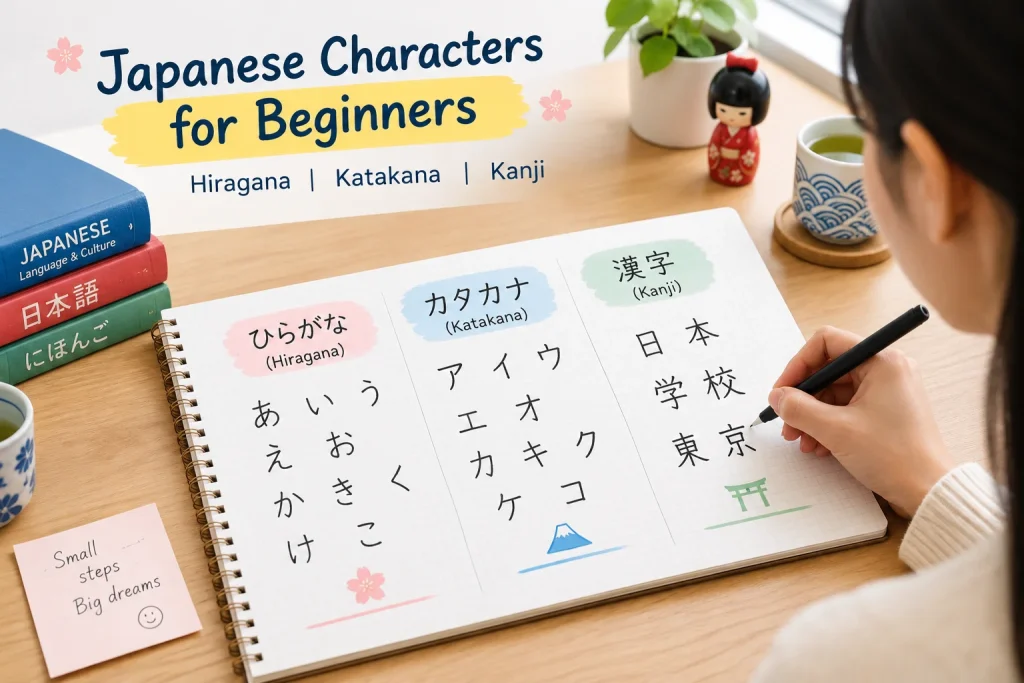
What Are Japanese Characters?
The Japanese language employs three primary scripts:
- Hiragana – Used mainly for Japanese words, grammatical forms, particles, and words that do not employ Kanji.
- Katakana – Used mainly for foreign words and scientific words.
- Kanji – Letters that originate from the Chinese writing system, representing ideas or meanings.
The Japanese language also makes use of Romaji – which represents the sounds of Japanese using the Latin alphabet. However, Romaji is not typically regarded as one of the three Japanese scripts. Surely, you can learn Japanese with the help of a Post Graduate Diploma in Japanese Language by Eduwatts.
Thinking About Learning Japanese?
For example:
| Japanese | Script | Meaning | Pronunciation |
| あ | Hiragana | a | a |
| ア | Katakana | a | a |
| 日 | Kanji | day/sun | hi / nichi |
| 人 | Kanji | person | hito / jin |
A Japanese sentence can contain all three scripts:
私はコーヒーを飲みます。
Here, 私 and 飲 are Kanji, は and を and みます contain Hiragana, while コーヒー is Katakana.
How Many Japanese Characters Are There?
A specific number does not exist because thousands of Kanji symbols exist in addition to a smaller number of Hiragana and Katakana symbols.
The basic Hiragana alphabet has 46 letters, while the basic Katakana alphabet has 46 letters. These can form additional letters using Dakuten, Handakuten, and small letters.
Nevertheless, Kanji is expansive. The Japanese language uses thousands of Kanji symbols. However, it is not necessary to learn all of them for basic knowledge of Japanese.
The government of Japan has listed 2,136 Jōyō Kanji that people can use in their daily lives.
Thus, the answer to how many characters are in the Japanese language depends on which characters you consider. New learners can begin with the 46 basic Hiragana and 46 basic Katakana characters.
The Three Types of Japanese Characters
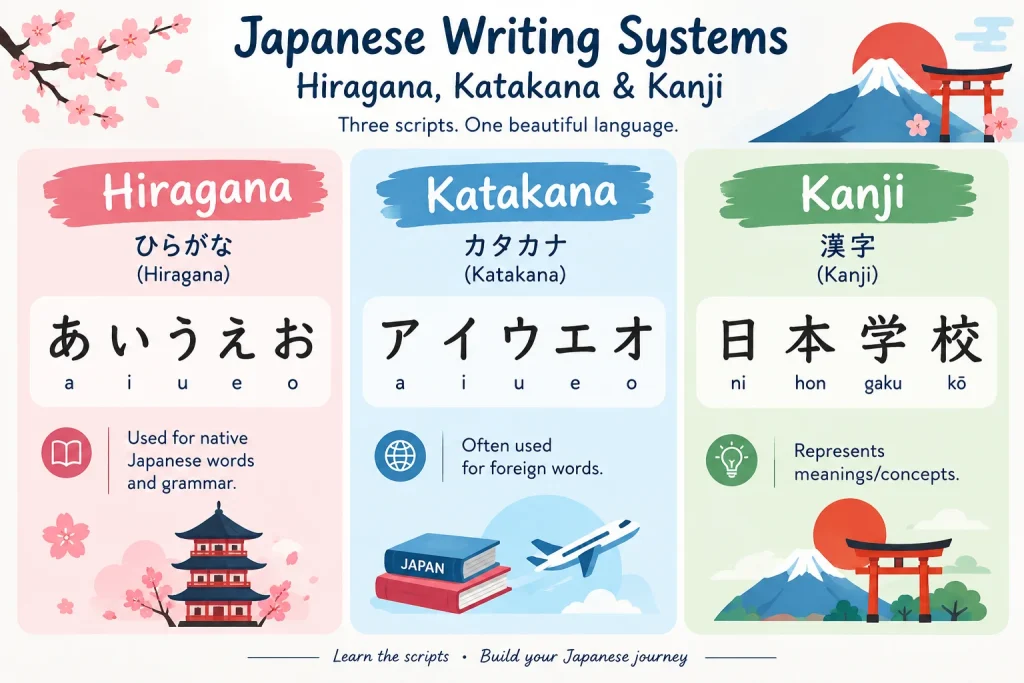
Japanese writers mix three scripts in a single sentence. Each has a different job.
| Script | Characters | Used for | Example |
| Hiragana | 46 basic | Grammar, native Japanese words | ありがとう |
| Katakana | 46 basic | Foreign loanwords, names, emphasis | コーヒー |
| Kanji | 2,136 daily-use | Core meaning of nouns, verbs, adjectives | 日本 |
A fourth system, rōmaji (Japanese written in the Latin alphabet), appears on train signs and in textbooks, but it is not a native script.
Difference Between Hiragana, Katakana and Kanji
The easiest way to recall the distinction is:
- Hiragana = grammar + native Japanese vocabulary
- Katakana = foreign vocabulary
- Kanji = meaning-based symbols
Sentences in Japanese normally contain all three.
For instance:
私は学生です。
Here:
- 私 = Kanji
- は = Hiragana
- 学生 = Kanji
- です = Hiragana
Another example is:
私はコーヒーを飲みます。
The word コーヒーuses Katakana because it is a loanword, while 飲is Kanji and the remaining grammatical elements use Hiragana.
If you wish to learn different types of characters in the Japanese Language, going for a Master’s (MS) in Japanese Courses will be the best choice.
Ready to Start Learning Japanese?
Hiragana Characters (ひらがな)
Hiragana is the first script learned by all students. The following hiragana syllabaries stand for sounds (syllables) and not meanings. Each hiragana syllabary stands for a sound, and therefore with knowledge of the syllabaries, any Japanese word can be pronounced.
Hiragana Characters Chart with Pronunciation
| Hiragana | Pronunciation | Hiragana | Pronunciation |
| あ | a | か | ka |
| い | i | き | ki |
| う | u | く | ku |
| え | e | け | ke |
| お | o | こ | ko |
| さ | sa | た | ta |
| し | shi | ち | chi |
| す | su | つ | tsu |
| せ | se | て | te |
| そ | so | と | to |
| な | na | は | ha |
| に | ni | ひ | hi |
| ぬ | nu | ふ | fu |
| ね | ne | へ | he |
| の | no | ほ | ho |
| ま | ma | や | ya |
| み | mi | ゆ | yu |
| む | mu | よ | yo |
| め | me | ら | ra |
| も | mo | り | ri |
| わ | wa | る | ru |
| を | wo | れ | re |
| ん | n | ろ | ro |
Hiragana Characters and Meanings
Individual hiragana characters have no meaning by themselves. These are phonetic characters, much like our alphabets. However, some have grammatical functions as well:
- は (wa): indicates the topic of a sentence.
- を (o): indicates the direct object of a sentence.
- の (no): indicates possession, similar to the English “‘s.”
- に (ni): means “to,” “at,” and “in.”
- か (ka): indicates a question.
- も (mo): means “also” or “too.”
Words written in hiragana are ありがとう (arigatō, thank you), おはよう (ohayō, good morning), and さくら (sakura, cherry blossom).
Hiragana Characters With Examples
Here are some useful Hiragana-based words for beginners:
| Japanese | Pronunciation | English meaning |
| ねこ | neko | cat |
| いぬ | inu | dog |
| さかな | sakana | fish |
| やま | yama | mountain |
| かわ | kawa | river |
| みず | mizu | water |
| はな | hana | flower |
| そら | sora | sky |
| あめ | ame | rain |
| ひと | hito | person |
| すし | sushi | sushi |
| ここ | koko | here |
| そこ | soko | there |
| いえ | ie | house |
| なまえ | namae | name |
These examples illustrate the reason why it is easy to learn characters in Japanese that have English meaning when studying the characters in words.
Katakana Characters (カタカナ)
Katakana letters contain exactly the same sounds as hiragana letters, yet their shape looks more pointed and angular. They are used in Japan for loaned words from other languages (テレビ, terebi), for foreign people’s names, for scientific terms and onomatopoeia.
Katakana Characters Chart with Pronunciation
| Row | Characters and pronunciation |
| Vowels | ア (a) イ (i) ウ (u) エ (e) オ (o) |
| K | カ (ka) キ (ki) ク (ku) ケ (ke) コ (ko) |
| S | サ (sa) シ (shi) ス (su) セ (se) ソ (so) |
| T | タ (ta) チ (chi) ツ (tsu) テ (te) ト (to) |
| N | ナ (na) ニ (ni) ヌ (nu) ネ (ne) ノ (no) |
| H | ハ (ha) ヒ (hi) フ (fu) ヘ (he) ホ (ho) |
| M | マ (ma) ミ (mi) ム (mu) メ (me) モ (mo) |
| Y | ヤ (ya) ユ (yu) ヨ (yo) |
| R | ラ (ra) リ (ri) ル (ru) レ (re) ロ (ro) |
| W + N | ワ (wa) ヲ (wo) ン (n) |
Katakana Characters and Meanings
Like Hiragana, individual letters of Katakana generally stand for sounds and not for meanings. Words taken from other languages often use Katakana.
| Katakana | Pronunciation | Meaning |
| テレビ | terebi | television |
| コーヒー | kōhī | coffee |
| パン | pan | bread |
| バス | basu | bus |
| ホテル | hoteru | hotel |
| コンピューター | konpyūtā | computer |
| レストラン | resutoran | restaurant |
| アイス | aisu | ice cream |
| タクシー | takushī | taxi |
| スポーツ | supōtsu | sports |
Katakana is also found in foreign names, product names, scientific terms, and some onomatopoeia.
Kanji Characters (漢字)
The Kanji are logographic characters originating from China and introduced into Japan in the 5th-6th centuries AD. Unlike Kana, each Kanji symbol has meaning and is pronounced in two ways:
- On’yomi (音読み) – Chinese pronunciation, frequent in compounds;
- Kun’yomi (訓読み) – Japanese pronunciation, frequent when the Kanji symbol is used alone.
This is why 日 can be pronounced both as nichi (in 日本 Nihon/Nippon… and 日曜日 nichiyōbi) or hi (“day”). Memorising Kanji characters this way greatly simplifies the learning process.
Kanji Characters List with English Meaning and Pronunciation
The kanji character list has 80 fundamental kanji for beginners categorised under topics. The readings are provided as on’yomi / kun’yomi.
Numbers
| Kanji | Meaning | Reading |
| 一 | one | ichi / hito(tsu) |
| 二 | two | ni / futa(tsu) |
| 三 | three | san / mit(tsu) |
| 四 | four | shi / yon |
| 五 | five | go / itsu(tsu) |
| 六 | six | roku / mut(tsu) |
| 七 | seven | shichi / nana |
| 八 | eight | hachi / yat(tsu) |
| 九 | nine | kyū / kokono(tsu) |
| 十 | ten | jū / tō |
| 百 | hundred | hyaku |
| 千 | thousand | sen |
| 万 | ten thousand | man |
| 円 | yen / circle | en / maru(i) |
Nature
| Kanji | Meaning | Reading |
| 日 | sun, day | nichi / hi |
| 月 | moon, month | getsu / tsuki |
| 火 | fire | ka / hi |
| 水 | water | sui / mizu |
| 木 | tree, wood | moku / ki |
| 金 | gold, money | kin / kane |
| 土 | earth, soil | do / tsuchi |
| 山 | mountain | san / yama |
| 川 | river | sen / kawa |
| 田 | rice field | den / ta |
| 天 | heaven, sky | ten / ame |
| 雨 | rain | u / ame |
| 空 | sky, empty | kū / sora |
| 花 | flower | ka / hana |
| 森 | forest | shin / mori |
| 海 | sea | kai / umi |
People
| Kanji | Meaning | Reading |
| 人 | person | jin / hito |
| 男 | man | dan / otoko |
| 女 | woman | jo / onna |
| 子 | child | shi / ko |
| 父 | father | fu / chichi |
| 母 | mother | bo / haha |
| 友 | friend | yū / tomo |
| 先 | previous, ahead | sen / saki |
| 生 | life, birth | sei / i(kiru) |
| 学 | study | gaku / mana(bu) |
| 名 | name | mei / na |
Body
| Kanji | Meaning | Reading |
| 目 | eye | moku / me |
| 耳 | ear | ji / mimi |
| 口 | mouth | kō / kuchi |
| 手 | hand | shu / te |
| 足 | foot, leg | soku / ashi |
| 心 | heart, mind | shin / kokoro |
Size and Direction
| Kanji | Meaning | Reading |
| 大 | big | dai / ō(kii) |
| 小 | small | shō / chii(sai) |
| 上 | up, above | jō / ue |
| 下 | down, below | ka / shita |
| 中 | middle, inside | chū / naka |
| 左 | left | sa / hidari |
| 右 | right | u / migi |
| 北 | north | hoku / kita |
| 南 | south | nan / minami |
| 東 | east | tō / higashi |
| 西 | west | sei / nishi |
Everyday Kanji
| Kanji | Meaning | Reading |
| 食 | eat, food | shoku / ta(beru) |
| 飲 | drink | in / no(mu) |
| 見 | see | ken / mi(ru) |
| 行 | go | kō / i(ku) |
| 来 | come | rai / ku(ru) |
| 出 | exit | shutsu / de(ru) |
| 入 | enter | nyū / hai(ru) |
| 本 | book, origin | hon |
| 車 | car | sha / kuruma |
| 電 | electricity | den |
| 語 | language | go |
| 話 | talk | wa / hanashi |
| 時 | time | ji / toki |
| 年 | year | nen / toshi |
| 国 | country | koku / kuni |
| 白 | white | haku / shiro |
| 赤 | red | seki / aka |
| 青 | blue | sei / ao |
| 黒 | black | koku / kuro |
| 愛 | love | ai |
| 力 | power | ryoku / chikara |
Japanese Characters and Meanings: Why Kanji Are Different
One of the frequent questions from beginners is why some characters have meaning while others don’t. The answer is very simple:
- Hiragana and Katakana = sounds. They function similarly to alphabets, although each character represents a full syllable.
- Kanji = meaning. Each character carries its own meaning, which is often combined with other meanings to form larger words.
For example, 日 (sun) + 本 (origin) = 日本 (Japan, literally “origin of the sun”) and 電 (electricity) + 車 (car) = 電車 (train).
After seeing the construction principles, even unknown kanji will seem logical to you because most of them consist of smaller components known as radicals.
The radical 氵 (water) can be found in characters such as 海 (sea), 河 (river) and 泳 (swim).
How to Write Japanese Characters?
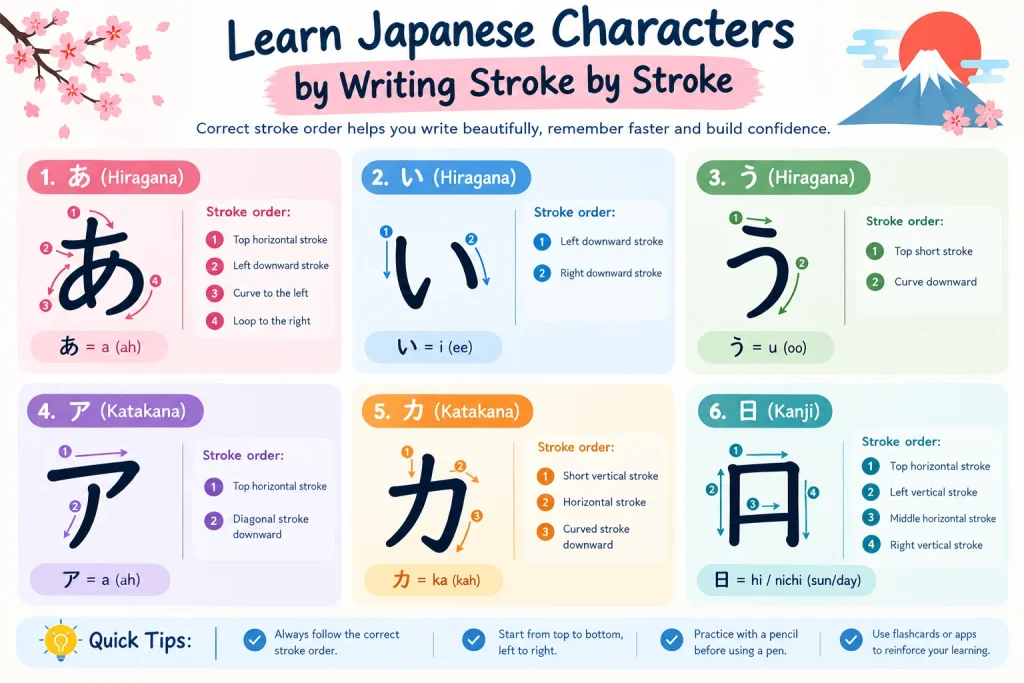
Knowing how to correctly write characters in Japanese can help you remember and recognise them. Here are some basic rules to observe when doing so:
- From top to bottom. Strokes begin at the top and flow down.
- From left to right. If there are several strokes in a row, write the left one first.
- Horizontal strokes before vertical. Horizontal strokes precede vertical strokes (ten is written horizontally first, and then vertically).
- Center before wings. When writing a symmetrical kanji character like 小, the center part should be done first.
- Outside before inside. First draw the frame and then the inside of an enclosed character like 国.
- Note the ending. Strokes in Japanese have different endings, called tome, hane, or harai, and they do matter.
Practical advice:
- Use genkō yōshi paper for better proportions.
- Mouth the sounds when writing each character.
- Write each character 10-20 times and then try to reproduce it from memory.
- Use applications that show animated stroke order, or practice writing characters with your finger on your phone.
50+ Japanese Characters: Beginner Learning Plan
A practical learning sequence looks like this:
| Learning stage | Target |
| Week 1 | Basic Hiragana |
| Week 2 | Remaining Hiragana + combinations |
| Week 3 | Basic Katakana |
| Week 4 | Katakana combinations |
| Week 5 | 20–30 basic Kanji |
| Week 6 | 30–50 additional Kanji |
| Week 7+ | Vocabulary and sentence reading |
Your exact learning speed will depend on your previous language-learning experience and daily practice time.
How to memorise characters in Japanese?
It makes it easy for you to learn more than 150 characters with a systematic process.
1. Start with Hiragana
Learn 46 basic Hiragana characters first.
2. Learn Katakana
Learn the equivalent Katakana characters once you feel comfortable learning Hiragana.
3. Learn Basic Kanji
Start by learning numbers, days, directions, people, places, and basic verbs.
4. Learn Words, Not Individual Characters
Do not simply learn 食 but learn words like:
食べる = to eat
5. Practice Writing
Learn to write the characters several times in the right stroke order.
6. Read Japanese
Read Japanese using stories for kids, books for beginners, labels, menus, and dialogues.
7. Review Frequently
It is easier to review on a daily basis than to try memorising many characters at once.
Common Mistakes to Avoid
- Avoiding hiragana and learning straight from rōmaji. Reading will be slow in the end.
- Learning Kanji without context. You should learn them in words, e.g., 学生 (student).
- Omitting stroke order. It influences readability, and stroke order is needed for dictionaries and handwriting input.
- Mistaking similar-looking characters. さ/き, ぬ/め, シ/ツ, ソ/ン, and 未/末.
Eduwatts – Best Institute for Learning Japanese

The ability to learn characters in Japanese will be easier because the combination of writing with speaking, listening, vocabulary, and culture is made possible. At Eduwatts, it is made possible for the learner to acquire more knowledge about the Japanese language with the help of the Japanese Language Courses(Level N5).
Regardless of whether one learns the Hiragana characters, Katakana characters, or the beginner Kanji characters, continuous learning and practice will make one feel confident. It will be possible for the learner to progress from the Japanese character level to Japanese sentences.
| Key Feature | What You Learn |
| Japanese Language Learning | Build a strong foundation in Japanese language skills |
| Courses for Different Levels | Japanese language from beginner to advanced levels like JLPT N5 to N1. |
| Hiragana & Katakana | Learn how to read and write the basic Japanese alphabets |
| Kanji Learning | Knowledge of basic Kanji characters, their meanings, pronunciations, and uses |
| Japanese Speaking Practice | Develop confidence in everyday Japanese conversations |
| Grammar & Vocabulary | Learn essential grammar rules, words, and sentence structures |
| Practical Japanese | Practise useful expressions for real-life situations |
| Japanese Culture | Explore Japanese traditions, customs, etiquette, and cultural practices |
| Interactive Learning | Strengthen skills through activities, examples, and communication practice |
| Structured Learning | Progress from basic concepts to more advanced Japanese skills |
| Goal-Oriented Learning | Prepare for communication, travel, studies, work, or personal learning goals |
| JLPT & NAT Preparation | Prepare for Japanese language proficiency examinations with focused learning and practice. |
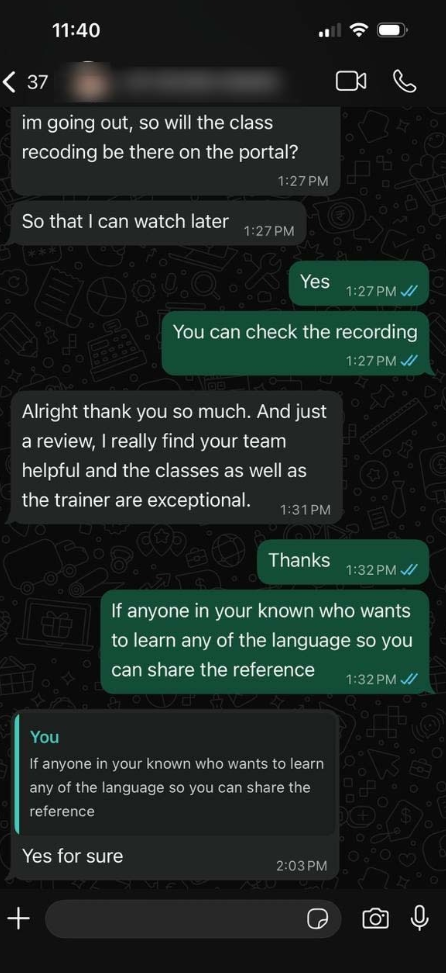
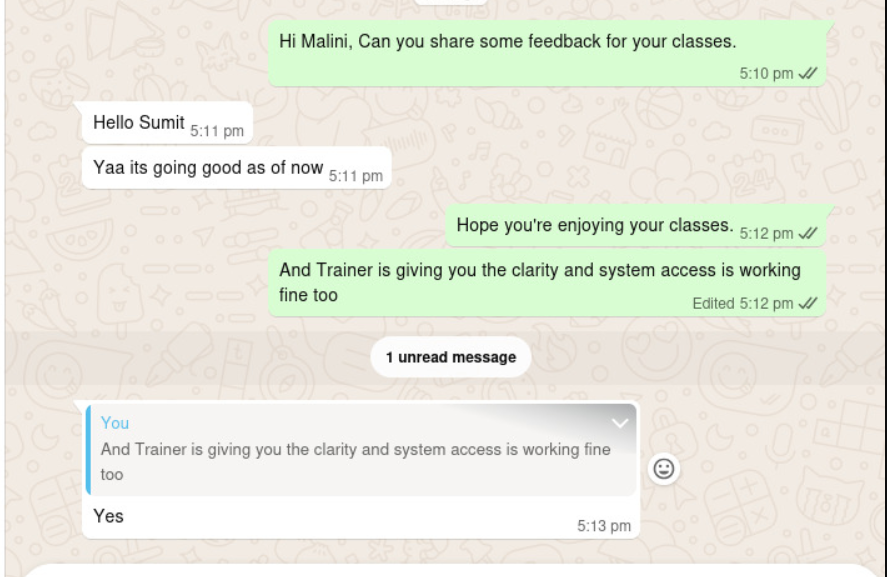
Eduwatts Reviews
A few More Level wise Japanese Courses at Eduwatts
- Japanese Language Course – N5 Level
- Japanese Language Course- N4 Level
- Japanese Language Course- N3 Level
- Japanese Language Course- N2 Level
- Japanese Language Course- N1 Level
Career Scope After Learning Japanese
Not only does knowing Japanese language provide possibilities of securing job opportunities in Japan, but also in India. The increasing number of Japanese companies working together with Indian companies makes those who know Japanese and possess some other skills also have plenty of options.
| Career Option | What You Can Do |
| Japanese Translator | Translate documents, websites, business materials, and other content between Japanese and English/Indian languages. |
| Japanese Interpreter | Help Japanese and Indian professionals communicate during meetings, conferences, and business discussions. |
| Japanese Language Teacher | Teach Japanese to students, professionals, and JLPT aspirants. |
| Japanese Content Specialist | Create, edit, or localise content for Japanese-speaking audiences. |
| Japanese Customer Support | Assist Japanese-speaking customers and clients through email, chat, or phone. |
| Japanese IT Professional | Combine Japanese proficiency with skills such as software development, testing, IT support, or project management. |
| Japanese Business Executive | Support communication and coordination between Japanese and Indian companies. |
| Import & Export Professional | Work with companies involved in India–Japan trade and international business. |
| Hospitality & Tourism | Assist Japanese tourists and work with hotels, travel companies, and tourism businesses. |
| Japanese HR/Recruitment | Support recruitment, communication, and coordination for companies working with Japanese clients or employees. |
| Jobs in Japan | Japanese proficiency can support opportunities in Japan, depending on your qualifications, experience, visa requirements, and language level. |
Japanese Language and Scope of Salary
The factors that will determine how much you earn include things like JLPT level, professional qualification, experience, industry, place of employment, and type of job. In general, it is easier to find a better career path by using Japanese with other skills such as IT, finance, management, engineering, health care, digital marketing, or teaching.
Which JLPT Level Helps Your Career?
- N5-N4: Basic understanding of everyday Japanese.
- N3: Helpful in gaining an intermediate level of conversation.
- N2: Often helpful for professional and workplace communication.
- N1: Advanced Japanese language proficiency.
To summarize, Japanese language can be an important skill in your career by using the knowledge you already have in any other profession or field. Students can acquire the skills in the Japanese language slowly and later find opportunities in fields such as translation, teaching, IT, business, customer service, tourism, and Indian-Japan business.
Talk to a Japanese Course Expert
Final Thoughts
Knowledge of the characters in Japanese is one of the most important keys to start reading and writing in the language. Learn the 46 basic characters of Hiragana, then study the 46 basic characters of Katakana and slowly increase your Kanji vocabulary.
Please remember that the role of Hiragana and Katakana is to show you sounds, while Kanji shows meaning. Learning the characters in context through words helps you better remember the Japanese language.
When you are in need of a Japanese characters list, Japanese characters chart, Japanese characters with pronunciation, or even Japanese characters and meanings, the only thing to do is practice regularly.
Start by learning a few characters daily, then practice writing, learn words and slowly transition from characters to sentences in Japanese.
Looking to expand your Japanese studies? At Eduwatts, we have a program that will ensure that you gain a solid base knowledge of the Japanese language through effective study, lesson plans, and practices. Contact Eduwatts and Check out the Japanese language program offered at Eduwatts to boost your Japanese language skills.
Recommended Reads
- How to Learn a New Language Online: A Complete Guide
- Best 10 Japanese Language Courses in Bangalore
- Most Spoken Language in the World: Facts, Rankings & Native Speakers
- Top Institute For Japanese Language Classes in Pune with Fees & Duration
- Mastering the Japanese Language Course: A Comprehensive Guide
- Learn Japanese course: A detailed Guide for Beginners
Frequently Asked Questions
It has 46 basic hiragana, 46 basic katakana, and 2,136 jōyō (everyday-use) kanji, which makes up to about 2,230 characters.
Taking into account all the kanji that were ever written down, more than 50,000. However, about 2,200 characters cover almost everything that might be encountered in everyday life.
Hiragana. It contains 46 characters, a fixed sound for each of them, and it is the base of everything else.
Hiragana, katakana, and kanji.
No. With just 1,000 kanji, it will be possible to read most of the everyday texts, and 2,136 will cover all newspapers and official documents.
Yes. Just install a Japanese keyboard, type in the rōmaji and choose the right characters from the list.
Both are made of the same sounds. Hiragana is used for native words and grammar, whereas katakana is used for foreign ones.
Ready to Start Your Learning Journey?
Join thousands of learners and build your future with expert-led courses and 100% practical training.

Nidhi Gupta
I am a full-time content writer who develops high-quality, engaging and SEO-friendly content for the Internet. The type of content I write includes blogs, articles, website content, and marketing content which educates customers and helps companies build their online presence. My specialty lies in developing high-value, well-researched and audience-oriented content. Apart from being an all-round professional content writer, I have vast experience in **healthcare content writing** where I develop highly accurate and customer-friendly content on hospitals, doctors, various medical specialties, diseases, healthcare courses and patient education material. I make sure each and every medical content I develop is well-researched, easy-to-understand and in line with the latest developments in the field of healthcare. Moreover, apart from health care writing, I have thorough knowledge about SAP concepts including SAP ERP and other business processes and enterprise solutions where I develop highly informative content related to SAP modules, digital transformation, business analytics and enterprise software.
View all articlesRelated Posts

Mastering the Japanese Language Course: A Comprehensive Guide
 Vineetha NairSep 5, 2024