.webp)
How to Learn Spanish Language: A Beginner’s Guide (2026)
 Pallavi SaxenaJul 21, 20261,493 views13 min read
Numerous students and working professionals are looking for how to learn the Spanish Language. Learning Spanish has become one of the smartest investments today for global job opportunities and rapid career growth. Moreover, language-passionate travellers and students looking for higher studies in Spanish-speaking countries want to learn Spanish quickly. Learners who desire to boost their language skills mostly explore the Best Way to learn Spanish. They mostly have such queries as: How Long Does It Take to learn Spanish? Or Can I Learn Spanish by Myself?
The good news is that Spanish is considered one of the easiest foreign languages for English speakers and many Indian learners because of its phonetic pronunciation and simple grammar. In this comprehensive beginner’s guide, we will explain how to learn Spanish from Scratch, the importance of Spanish Language Certification Benefits, Career Opportunities after learning Spanish and more.
Why Learn Spanish?
Spanish is among the world’s fastest-growing languages. Language specialists say you can hear it in Spain, Mexico, Argentina, Colombia, Chile, Peru and more. Mastering a foreign language will not only break the language barrier, but it also opens up opportunities for top job roles in various industries.
Here are the top reasons to learn Spanish:
- Communicate with over 500 million native speakers worldwide.
- Improve your chances of working with multinational companies.
- Access better study-abroad opportunities in Spain and Latin America.
- Increase your earning potential in international organisations.
- Explore Spanish literature, cinema, music, and culture.
- Enjoy smooth and interactive travel experiences in Spanish-Speaking Countries.
- Enhance cognitive abilities such as memory and problem-solving.
- Build confidence as you can speak confidently in Spanish – one of the world’s most influential languages.
Spanish is no longer just a language, but has proven to be an essential language skill to break the language barrier in career growth and business expansion. Amongst all top languages, Spanish is a language that is in high demand and a valuable professional skill in today’s global economy.
How to Learn the Spanish Language?
The key to learning the Spanish language is the right learning approach, quick tips to follow and consistent practice. Even though Spanish has its own grammar and vocabulary, the fact that Spanish words are pronounced almost exactly as they are written makes learning it pretty simple. Guidance from Spanish Expert Trainers will enable learners to find their feet to speak Spanish in just a few months.
Effective Methods to Learn Spanish successfully
- Set Clear Learning Goals
Need to set Clear Learning Goals for your Spanish learning. Your goal may be a career, education abroad or travel. A goal provides a sense of motivation throughout your learning journey.
- Learn Basic Vocabulary
Start with simple words, which might be common nouns, greetings, numbers and colours, names of family members, commonly conversational verbs or expressions used in normal conversations. Working on vocab first can help the conversations flow much more easily.
- Understand Spanish Grammar
Grammar is the basis of all languages. Instead of trying to memorise grammar, learn it gradually.
- Practice Listening
Listening improves pronunciation and comprehension. Use Spanish videos (watching beginner-friendly content), podcasts, movies and news channels with subtitles to grasp how natural conversations unfold.
- Speak Every Day
Speaking regularly builds confidence. Practice with classmates, teachers or language partners will improve your Spanish skills.
- Read Spanish Content
Begin with everything from children’s books to newspapers, blogs, and short stories. Reading will broaden your vocabulary as well as improve your grammar, with neither being blatantly forced.
- Write Daily
Maintain a journal in Spanish. Daily writing of simple sentences strengthens vocabulary and improve your language skills.
- Enrolling in a globally recognised Spanish Language Institute
Trainers will give structured lessons, speaking practice, assessments and guidance on certificates so that you progress much faster.
Best Way to Learn Spanish for Beginners
While every learner is unique, the following methods have been consistently showing the best results:
- Master Everyday Vocabulary First
Practise daily basic vocabulary such as common words, greetings, small talk, numbers/colours/all food-related things and travel-related words. A good range of vocabulary is essential for quickly and easily learning grammar.
2. Learn Grammar Step by Step
First, make a strong foundation in Spanish Grammar. Once you have mastered the present tense, simple sentence structures, and articles and pronouns. You can move forward to advanced-level Spanish language learning.
3. Practice Listening Every Day
Listen to Spanish podcasts, YouTube channels, and conversations every day. It will help you pronounce it correctly and understand native speakers more naturally!
4. Speak Without Fear of Mistakes
Beginners hold back from speaking due to the fear that they will make mistakes. Keep in mind that making mistakes is part of the learning process. You gain confidence quickly by speaking the more you practice.
5. Prepare for Spanish Certification
Pursue a Spanish language Certification Course that is globally recognised and opens global job opportunities for you. The certificate gives clear objectives to work towards and inspires students to develop all the language skills: reading, writing, listening and speaking.
Common Mistakes Beginners Should Avoid
Many learners slow their progress by making avoidable mistakes. Here are some common ones:
- Translating every sentence from English.
- Memorising vocabulary without using it in conversations.
- Ignoring pronunciation practice.
- Studying irregularly instead of daily practise.
- Avoiding speaking because of fear.
- Depending only on language-learning apps.
- Skipping grammar basics.
- Not practising listening skills.
Avoiding these mistakes can significantly accelerate your journey toward fluency.
Significance of Spanish Language Certification
A Spanish language certificate is much more than a piece of paper. It is proof of your ability to use the Spanish language that can further boost your academic and professional profile. You can read, write, listen and speak Spanish. Here are some key reasons why earning a Spanish language certification is important:
- Globally Recognised Qualification
Your new language skills will also have international validity, with Spanish certifications accepted by universities, employers and government organisations around the world.
2. Better Employment Opportunities
This is because recruiters often prefer certified candidates, as employers trust standardised language assessments more than self-reported proficiency.
3. Higher Education Abroad
Many universities across Spain and Latin America require applicants to show evidence of their Spanish language skills when applying for under- and postgraduate courses.
4. Career Advancement
If you have a certification for Spanish, then it opens up the gate for promotion and overseas assignments.
5. Personal Achievement
Certification preparation enables a well-rounded development of reading, writing, speaking and listening abilities as well as confidence.
6. Imprved Communication Skills
These courses can help improve how you communicate in the real-world through practical conversations, presentations, and comprehension exercises as part of certification preparation.
7. Competitive Advantage
With the stiff competition in the job market today, an internationally acknowledged Spanish certificate elevates your resume over other contenders.
Popular Spanish Language Certification Levels
Spanish proficiency is commonly assessed according to the Common European Framework of Reference for Languages (CEFR).
| Level | Proficiency |
| A1 | Beginner |
| A2 | Elementary |
| B1 | Intermediate |
| B2 | Upper Intermediate |
| C1 | Advanced |
| C2 | Near Native Fluency |
Each level evaluates listening, reading, writing, and speaking skills progressively.
Eduwatts: Top Spanish Language Institute

Eduwatts is known to be one of the best online learning platforms in India to provide certification courses that are focused on jobs, academic success and professional growth. Dedicated courses for beginners to working professionals who are planning on pursuing Spanish language studies with a focus on practical communication skills.
The institute focuses on interactive live classes, experienced trainers, flexible timings, live speaking practice, and study materials. The learning process is also well complemented with continuous mentorship, doubt-clearing sessions and guidance for internationally recognised Spanish language examinations.
Eduwatts caters specifically to students with its learner-centric teaching methodology and career-oriented curriculum. Through profession Al learning methods, Eduwatts prepares them for overseas opportunities in education, business & tourism and multinational organisations by enhancing their confidence levels as well as fluency in the language used throughout the world.

Top Spanish Language Courses
- Spanish Language Course – A1 Level
- Spanish Language Course – A2 Level
- Spanish Language Course – B1 Level
- Spanish Language Course – B2 Level
- Spanish Language Course – C1 Level
- Spanish Language Course – C2 Level
Instituto Spanien: No.1 Spanish Language Institute in India

Instituto Spanien by Henry Harvin provides high-quality online education. The institute provides the latest and updated Spanish Language Courses. We focus on Spanish language skills- listening, speaking, reading, and writing. Our Spanish Language Courses are well-designed as per the CEFR, ranging from level A1 to C2.
Instituto Spanien provide highly experienced and Spanish Expert Trainers that speak Spanish like a native. Fluently speaking in Spanish has attracted numerous students and working professionals to pursue the top Spanish Language Courses from us. We emphasise the importance of learning Spanish proficiently and its value in professional and business contexts.

Top Spanish Language Courses
- Spanish Language Course
- Post Graduate Diploma in Spanish Language By Dunster Business School
- Spanish Creative Writing – Advanced Level Course
- Spanish Fluency Advanced Level Course
- Spanish Pronunciation Course
- Mastering Spanish From Beginner to Advanced Level
- DELE & SIELE Exam Preparation Course
Daily Study Plan for Spanish Beginners
A consistent study routine can help you achieve faster results. Here’s a simple one-hour daily plan:
| Activity | Time |
| Learn New Vocabulary | 15 Minutes |
| Grammar Practice | 15 Minutes |
| Listening Practice | 10 Minutes |
| Reading Practice | 10 Minutes |
| Speaking Practice | 10 Minutes |
Following this schedule consistently can significantly improve your Spanish skills within a few months.
Tips to Become Fluent in Spanish Faster
If your goal is fluency, follow these practical tips:
- Practice speaking every day.
- Do not translate; think in Spanish.
- Read Spanish newspapers and blogs.
- See the Spanish Ace series with subtitles
- Listen to Spanish podcasts daily.
- Set a goal of learning five to ten new words per day.
- Revise vocabulary regularly.
- Join conversation clubs.
- Record yourself speaking.
- Stay patient and consistent.
Keep in mind that if you want to be fluent, just like anything else, you have to practice it long term and not cram it once or twice a week.
Career Benefits of Learning the Spanish Language
Spanish is one of the most sought-after foreign languages in global market domains where it is applicable. Some of the biggest advantages to your career are:
- Better Job Opportunities
Hence, many multinational companies look for bilingual people to work with their sales (Spanish-speaking clients), customers or business partners in international markets.
- Higher Salary Packages
If you are an employee with knowledge of the Spanish language, most probably your salary package will be better since if workplaces look for bilingual professionals, they tend to pay higher compared to those who know only their native language.
- International Career Growth
Spanish leads to careers in Europe, Latin America, the United States and multinational companies dealing with Spanish-speaking countries.
- Opportunities in Multinational Companies
Few industries looking for employees who are able to communicate in Spanish include international trade, customer service, finance, IT, and consulting.
- Study Abroad Advantages
Speaking Spanish also opens more doors at top-ranked universities in Spain and Latin America, meaning that mastering it can help improve your scholarship opportunities.
- Freelancing Opportunities
Freelance Spanish translator, interpreter, content writer, tutor and language trainer for clients from all around the globe.
- Tourism and Hospitality Careers
Employees who are able to communicate with Spanish tourists are preferred by hotels, airlines, travel agencies and tourism companies.
- Government and Diplomatic Careers
Various government-aided agencies, embassies and international organisations hire experts with proficiency in foreign languages for different communication jobs.
- Business Expansion
Allow entrepreneurs to converse directly with their Spanish-speaking customers and have more effective business dealings in worldwide markets.
- Improved Professional Confidence
On an international level, you sharpen your skills, contacts and the confidence needed for business in a multicultural context.
Top Jobs After Spanish Language Certification
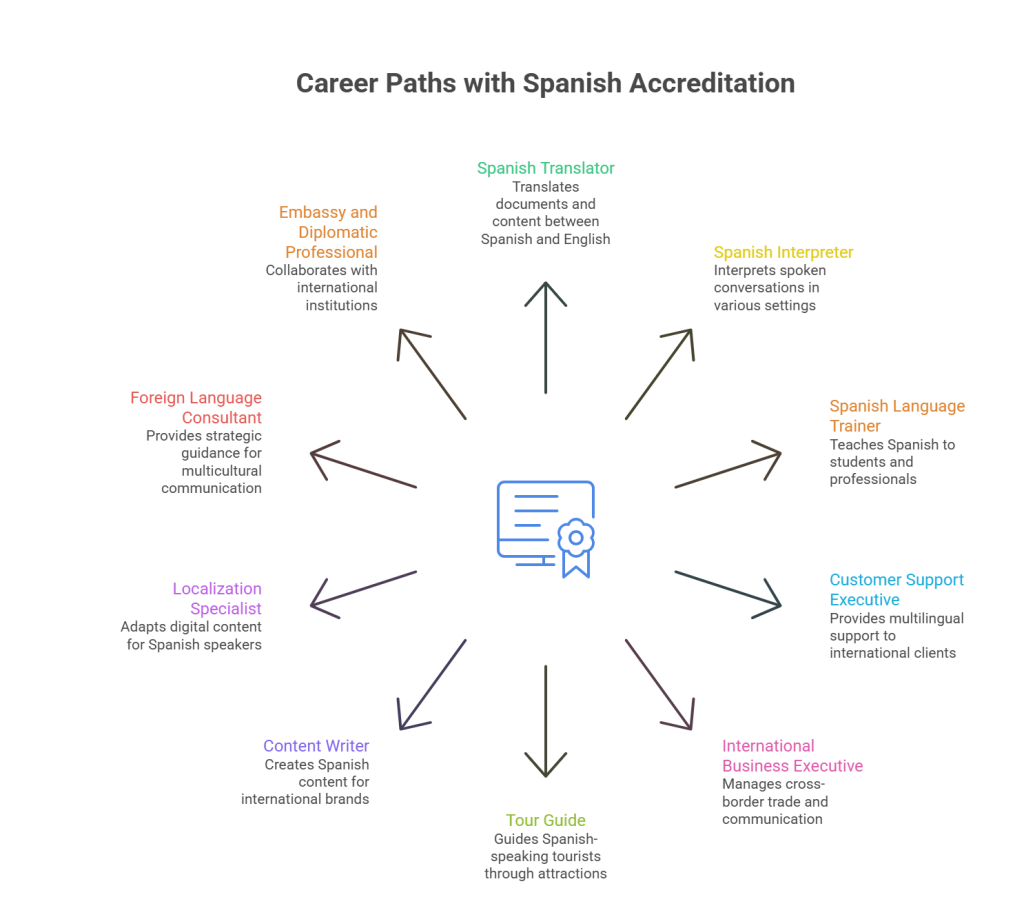
Obtaining a Spanish accreditation exposes you to many interesting professions in various sectors.
1- Spanish Translator
Translate business documents, legal papers, educational materials, books, websites, and marketing content between Spanish and English for organisation worldwide.
2- Spanish Interpreter
Interpret spoken conversations during meetings, conferences, legal proceedings, healthcare consultations, and international business discussions.
3- Spanish Language Trainer
Train students, professionals, corporate workers and language lovers through school, college, coaching classes or online.
4- Customer Support Executive
Multilingual customer support for international clients to work with Global BPOs, IT companies, Airlines, Banking And e-commerce Companies.
5- International Business Executive
Oversee cross-border trade and international operations, while managing communication with Spanish-speaking customers, vendors or business partners.
6- Tour Guide
To guide Spanish-speaking tourists, explaining the significance of historical sites, cultural attractions & travel destinations while providing a fun-filled experience while travelling.
7- Content Writer
Write blogs, website content, ads, social media posts and marketing campaigns in Spanish for international brands.
8- Localization Specialist
Culturally adapt all software, websites, mobile applications, games and digital content to Spanish speakers around the globe.
9- Foreign Language Consultant
Provide strategic guidance for multicultural communication, language training, localisation, and international market expansion.
10- Embassy and Diplomatic Professional
Collaborate with embassies, consulates, cultural organisations, and international institutions demanding advanced Spanish voice skills.
Conclusion
Learning Spanish is one of the most rewarding decisions you can make in 2026. In addition, the Spanish language equips you with great professional skills that can help you in global careers. Moreover, numerous students learn the Spanish language for higher education. Business owners learn spanish for international business opportunities and trade. Numerous learners ask, how to learn the Spanish Language? Pick the appropriate learning method, consistency of practice and remaining perseverant during your Spanish langauge journey.
Start with basic vocabulary, strengthen your grammar, and listen and speak daily in Spanish. Look to the Professional Spanish Language Institute to provide a proper guide for you! Achieving an internationally recognised Spanish certification enhances your profile and boosts your career prospects. Keep in mind, language acquisition is a long journey; every little step brings you one step closer to fluency. With persistence, practice and the right guidance, you can speak Spanish and open up incredible avenues for your future.
Recommended Reads
- Cervantes Vs Instituto Spanien by Henry Harvin– Choose The Best Spanish Language Training
- How to Learn Chinese Language at Home: A Complete Guide
- Best Spanish Books for Beginners (2026 Guide)
- Spanish Language Exchange: The Benefits of Tandem Learning
- Scope of Spanish Language in India
FAQ
Yes. Spanish is one of the easiest foreign languages for beginners due to its phonetic pronunciation, relatively simple grammar rules and useful vocabulary. Learning Spanish is so much easier with daily practice and a bit of structure.
Ans. Yes, with an hour of study a day for three months, you can attain basic conversational ability. Right, it takes continued practice, speaking exercises and exposure to the language over several months before reaching intermediate or advanced fluency.
The fastest way is to take a professional Spanish class and speak every day. Do vocabulary-building practices daily.
Ans. The DELE certification is the most recognised Spanish language certification. It is globally acknowledged by universities and employers as well as government institutions all across the world.
Ans. For practising basic grammar and building vocabulary, Duolingo is great. If you want to become fluent in Spanish and use the language professionally, you must pursue Spanish Certification Courses.
Ready to Start Your Learning Journey?
Join thousands of learners and build your future with expert-led courses and 100% practical training.

Pallavi Saxena
With over 15+ years of experience, I am working as an SEO Content Creator in different domains. My expertise spans a diverse range of industries, including technology, AI, Data Science, Languages, Healthcare, manufacturing, finance and more. As an SEO blog writer, I pen down words that give updated information as per industry innovation, upgradation and technological advancements. My passion lies in crafting compelling content that engages and motivates my readers.
View all articles




Recent Comments (15)
Very well-written and encouraging. Looking forward to reading more language-learning guides like this in the future.
Great work! Learning Spanish has been on my goal list for a while, and this article has motivated me to finally begin.
This is one of the most practical beginner guides I’ve come across. Easy to understand and full of actionable advice.
I enjoyed reading this! The advice on using apps alongside real conversations makes a lot of sense.
Thanks for explaining everything so clearly. This is a great resource for anyone starting from scratch.
Fantastic guide! I wish I had found an article like this when I first started learning Spanish.
The tips about building vocabulary gradually were especially useful. Looking forward to more language-learning content.
Very informative post! I’ll definitely try incorporating daily practice into my routine after reading this.
I appreciate the focus on speaking and listening from the beginning. That’s something many learners overlook.
Learning a new language can be overwhelming, but this article breaks everything down into manageable steps. Well done!
This guide answered many of my questions about where to start with Spanish. Thanks for putting it together!
Excellent article! The recommended resources and learning strategies are very helpful for beginners.
I really liked the emphasis on consistency over perfection. That’s such an important mindset for language learners.
Thanks for sharing these practical tips. I’m just starting my Spanish journey, and this was exactly what I needed.
Great beginner-friendly guide! The step-by-step approach makes learning Spanish feel much less intimidating.