.webp)
A professional who has completed the SAP Ariba course can understand the difference between a person buying products on e-commerce platforms and a multinational company buying 500 laptops or ordering lakhs worth of cafeteria inventory from listed vendors. Around the world, large companies use SAP Ariba for their day-to-day purchasing and supply chain operations. The company’s shopping approval process includes specific terms covering procurement, invoicing, workflow, and vendor management. They employ professionals trained in the SAP Ariba Course who understand those terms and the process. There are over 80 SAP modules, and demand for SAP Ariba has grown over the years due to its cloud-based capabilities.
A student with no prior knowledge of SAP basics may not understand all the business terms or the learning approach in the Ariba module. Unlike C, C++, and Java platforms, there is no open platform available for practice. The advanced SAP Ariba servers are not budget-friendly. Because of this, deciding how to proceed with the course and institute choice feels like a painful task. Taking a course from a well-reputed institute paves the way for a better understanding. To guide you out of the maze, we provide details on the SAP Ariba course, fees, eligibility, syllabus, career scope, and the institute in this blog.
Details of SAP Ariba Course :
Ariba was a company founded in 1996. SAP and Ariba set their standards as separate organisations and merged in 2014. SAP has taken care of the technical and coding aspects, eliminating the need for individual technical involvement. After the integration, professionals working on the SAP Ariba platform have a complete focus only on functional aspects. With the rise of digital presence, automation, and cloud-based solutions, SAP Ariba is an essential ERP for industries and organisations.
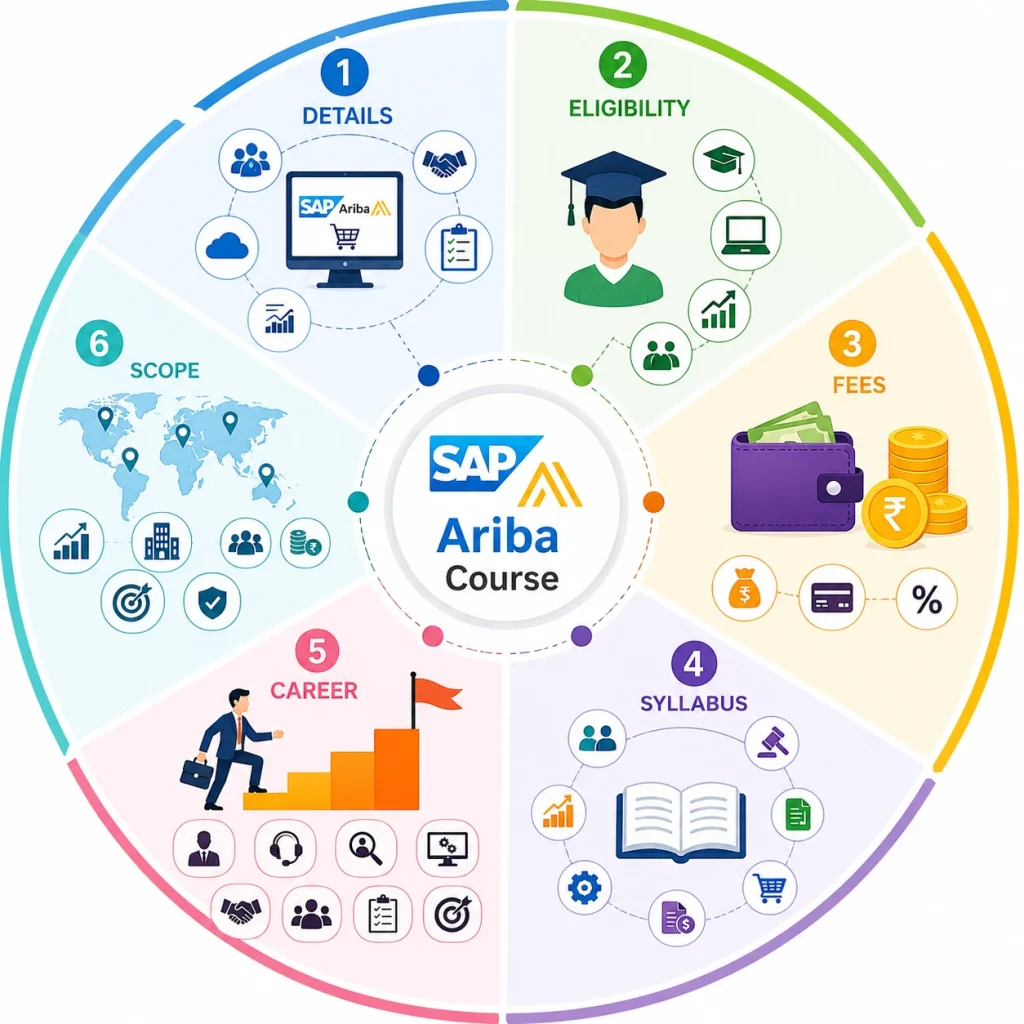
SAP Ariba is an end-to-end, automated, cloud-based SaaS procurement platform replacing time-taking and error-prone approaches. Companies depend on the Ariba platform for their business. Professionals depend on the platform for their careers. Initially, the terms related to buying, sourcing, cloud-based accounting, and reporting may be confusing.
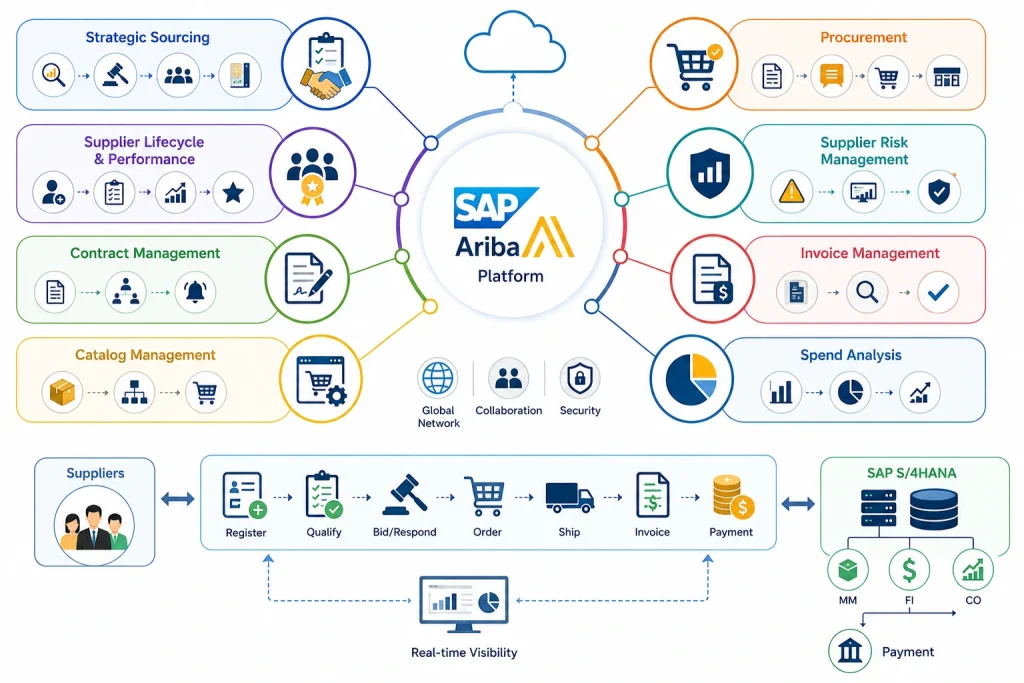
By understanding the basics, individuals can begin exploring advanced topics in the SAP Ariba procurement cycle. The SAP Ariba cycle involves:
Purchase requisition -> Approval -> Purchase order -> Supplier Delivery -> Goods Receipt -> Invoice -> Payment
There are two ways to proceed with the course training: Freshers usually start with the basics of SAP and the basics of upstreaming and downstreaming concepts in the business. With this choice, anyone can procure overall knowledge. However, for deep conceptual knowledge at the module level, training on a specific stream is more suitable. In addition to these concepts, to reach a senior level, individuals need knowledge of Excel reporting, supplier communication, invoice handling, and business analytics.
Eligibility Criteria:
Checking SAP Ariba course eligibility criteria before joining any course is a safe approach, but these days eligibility is not a big concern, except in the medical field. Any graduate with an interest in ERP can join the course. A postgraduate or graduate from any domain with basic knowledge of SAP can enrol.
- Basic concepts are introduced for beginners. So students without prior knowledge will also be able to ramp up easily.
- For intermediate- and advanced-level courses, individuals with basic knowledge of procurement can focus on high-level concepts rather than starting from the basics.
- Professionals with experience in any SAP module and seeking a career change are also eligible.
- All SAP MM consultants with ERP and inventory knowledge need to know SAP Ariba, and it’s easy for those professionals to learn the course.
- Based on current requirements, SAP will integrate Ariba and S/4HANA in the near future, and professionals will need to be aware of potential integration issues.
- Proper conceptual knowledge and practice lead to early job and career growth, irrespective of educational qualifications.
- Suitable for business administrators, Engineers with basic IT skills, and science graduates. Even arts students can enrol, but they need to put in extra effort to understand business-related terms and basics
Fees Details:
Depending on geographical factors, the type of institute, and the mode of learning, SAP Ariba Course fees vary. There are various methods for learning SAP Ariba. It’s a completely individual choice on which approach to follow. Experience level, individual capability, and budget are the main factors to consider before joining any course.
1. Self-Study and Practice Via SAP Servers:
Paid Online SAP Course recordings are available for 6k to 15k from premium YouTube tutorial channels, and access to practice using sandbox servers. YouTube videos will help you understand the course. Professionals with basic knowledge can proceed with the recorded YouTube videos. Many paid online videos on YouTube also help with doubt-solving sessions. Server access is provided to registered students for online practice in the SAP Ariba environment during the specified time slots. Students can learn theory in several ways, but for practice, subscribing to SAP learning centres is advisable, as SAP Ariba jobs require 100% practical exposure. With experience in SAP MM or SAP SRM, one can choose a self-study approach.
2. Online Live Training Institutes :
Virtual Training is always a preferable option for flexible timings alongside self-study. Working professionals, students in remote areas, and those who need flexible timing can use the online training mode. Similar to classroom training, online courses also provide guidance, placement support, and access to SAP servers for practice, making learning easy for students. The availability of the practice platform determines the fee structure. Fees usually range from 25k to 50k. Premium course fees are for the complete curriculum, sandbox access, internships, projects, and placement guidance.
3. Premium Training and Practicals:
SAP-certified institutes provide training access to servers with extended facilities and the latest versions. They provide extensive server access, which is an important factor in increasing your chances of getting a job with a high package. The course fees are high compared to other training modes mentioned above. They charge 1 lakh to 2 lakh just for the training. Certification costs extra. This mode is an appropriate training method for a fresher who needs maximum support and guidance, with placement prioritised.
Course Syllabus:
The SAP Ariba Syllabus should cover everything from the basics to advanced topics, depending on the course design. Here is the detailed syllabus, irrespective of the institute. The syllabus is divided into categories, starting with the basics, details of cloud-based procurement, and the corresponding steps in the company’s purchase cycle. The training institutes should design the course so that certificate exam preparation is also covered. As the certification exam cost is slightly above average, proper preparation and coverage of essential topics are mandatory. Opting for certification is a personal choice that depends on your career goals and is not mandatory.
Introduction Part :
- Knowing the basics related to buyers, suppliers, network, integration and ERP systems are the first steps to reach an understanding of the importance of this platform
- Steps involved in comparing buyers, such as bid amount, reputation, delivery time, and final analysis of selected proposals
- Importance of the Ariba network and the reasons for its widespread use by major companies.
- How the SAP Ariba platform is better suited for processing than the previous methods of Email, phone, and manual proposals.
- Creating business profiles, buyer and supplier profiles through invitations, registrations, and maintenance of trading.
- Different Ariba solution bundles and how to choose the required bundle as per business needs
Supplier Life Cycle Details:
- Working on behalf of a company, the motive should be a smooth purchase and payment transfer. For this, the professional should also be aware of the supplier side.
- Requesting suppliers to submit details, completing supplier verification and navigating with the supplier are covered. Every company has its own set of rules for selecting a partner; Ariba professionals should be familiar with the specific rules and steps for supplier verification.
- Requesting information and proposals are two entirely different procedures. The ability to differentiate them is learned in this part of the course.
- Students will learn about auctions, supplier comparisons, evaluation, and how to determine suitable suppliers based on pricing, delivery methods, quality, and time.
- End-to-end cycle of supplier registration to final evaluation.
Reporting and Documentation:
- Maintaining a supplier database using Excel and reporting are introduced.
- Supplier contract terms/agreements, documentation; understanding different contract types and their structural attributes, such as supplier details, pricing, timing, and management.
- Complete procurement life cycle of purchase. Steps involved in request creation, updating, approval, order conversion, supplier receipt of the details, and the final transformation to payment are covered.
- Purchase requisition, purchase order, receiving goods, processing invoices, making payments.
- The importance and usage of navigational features are the main topics in this category.
SAP Ariba Configuration
- Configuring SAP Ariba to meet company needs, such as the required number of approval levels, adding custom fields, maintaining company-specific fill-out forms, and understanding all the automation the system performs.
- Creating private and public workspaces, sharing required information for approvals, scrutinising pending tasks, and reporting the outcomes.
Data exchange :
- Integration of Ariba and s4/Hana along with all the Ariba communication systems information.
- Different ways to manage data: files, XML APIs, and cloud integration gateways.
- Introduction to the integration manager tool and the functionality of the tool in solving troubleshooting issues related to integration.
- CIG basics, importance and usage are explained
Ariba Network and Administration:
- The various steps involved in RFQ creation through payment completion are sample topics in this category.
- Details of work done by the administrator, configuration, and implementation are provided.
- Network maintenance is required for smooth functionality. Networking includes creating, managing, and uploading templates, defining approvals, migrating data, and managing procurement workflows.
- Different types of Ariba Network accounts are introduced—their features, limitations, and suitability to businesses.
- From the supplier side, all tasks are handled, from account creation to transaction completion.
Career Opportunities and Scope:
SAP Ariba Career and SAP Ariba scope features are listed here along with the job designations of junior and experienced levels. A multinational company in need of 100 laptops for new employees, or a manufacturing company about to purchase tons of raw materials, depends on the SAP Ariba platform and its professionals. The operations employee should know how to raise the request, who approves it, how the supplier receives the PO, how the delivery is confirmed, and how to match requests with invoices. A professional should be familiar with the above terms and steps to work as an entry-level SAP employee.
Individuals with knowledge of topics such as material master, vendor master, purchase requisition, purchase order, goods receipt, invoice verification, and the procurement cycle can move on to SAP Ariba functional consultant roles. Across all industries, there is a high demand for SAP Ariba consultants. Different roles that focus on simple operations, management and support to other staff are :
- Junior SAP Ariba Consultant
- SAP Ariba Support Analyst
- Sourcing operations specialist
- Procurement Data Analyst
- SAP Ariba Helpdesk Associate
- Supplier onboarding specialist
- Ariba Buyer Associate
With 2 to 6 years of experience and knowledge of the procurement process, anyone can avail the opportunities. A few of the job roles suitable for experienced professionals are:
- Functional and technical consultant
- Integration consultant
- Operations manager
- SAP Ariba delivery manager
- Freelance contractor
SAP Ariba and SAP S4/Hana integration makes aspirants suitable for many job options. Once an individual enters the SAP Ariba field, there is no need to consider a career change or plan for another course. All industries have requirements for buying and selling. The scope in this field is a clear, unobstructed pathway with a steady slope of career growth.
Training Institute for SAP Ariba Course

While choosing the institute for the course, there are a few main essential details to check for:
- Does the training institute provide training in all SAP modules? There is a need for professionals to understand how to integrate Ariba with other modules. If the institute provides SAP Training in all other modules, learning and practising the integration becomes easy.
- Is there server access for practical training? Knowing just the theory is not of use at all. Without practice, there is no way to get placed.
- Are there online and classroom provisions? Sometimes, problem-solving and practice require face-to-face discussions, and it is helpful to meet other students and learn about different situations.
- Scheduling class timings as per personal choice: For working professionals and final-year students, flexible class timings make learning at their convenience possible
- Guidance with doubt-solving and practice: As the practice servers are costly, students should practice and resolve their doubts on the spot.
- Mock interviews, assessments, and corrections: For fresh graduates, interviews may be a new experience. It is advisable to practice mock interviews to prepare for unexpected questions.
- Placement options with all types of industries: After the course, based on your interest, you can choose the industry and job location—individuals gain exposure to the full buyer-supplier process in their day-to-day work. Companies prefer individuals with experience across the entire architecture.
Eduwatts: Institute for SAP Ariba Training
We constantly hear that fresher roles are uncommon in SAP. The real meaning is that professionals with practical server experience are preferred. Eduwatts offers an SAP Ariba course that combines training and practice. All important SAP module courses, including integration topics, are designed by Eduwatts.

In addition to SAP basics and modules, Eduwatts offers courses for medical coders, billers, and paramedical professionals. Eduwatts has a history of delivering over 375k online classes, partnering with over 50 companies, and running a major placement drive for students and professionals. Eduwatts consistently strives to improve its team, procedures, assistance, and placement support. Every detail is provided on the website, giving a very clear idea of why to choose Eduwatts as your SAP Ariba training partner.
Eduwatts offers discounted courses for student alumni members. With this option, a beginner can start with the SAP Ariba Training course and extend the course to other SAP modules at a discounted price. Flexible class timings help balance classes, practice, and work for a working professional. Students from other countries or remote areas can also avail the training through live online classes. Eduwatts supports students from abroad with their country-specific requirements.

Eduwatts’s SAP Ariba course includes :
- Ariba Basics
- End-to-end supplier process known as SLP
- Sourcing process in Ariba
- Contracts management in Ariba
- Upstream and downstream processes in Ariba
- Reporting, Integration and buying process
- The Ariba platform’s complete interface, including tabs, windows, and network-related choices
By enrolling in Eduwatts, students can take a course tailored to industry standards, participate in guided internships, and receive support to attempt the certificate exam. Eduwatts partners with many Fortune 500 Companies. Through this, learners can receive placement offers and gain exposure to the working environment. By signing up with Eduwatts, students can enjoy 50+ soft skills courses, 1-year gold membership access to the course, LMS, doubt-solving, and a job portal.
Conclusion :
Students can select a training institute based on factors such as flexible class schedules, budget, server access, learning mode, and placement guidance. Internships are one of the best opportunities to gain industry exposure. They are similar to work experience. With this, beginners can overcome the myth that SAP jobs are stagnant and that they prefer only experienced personnel. In addition to the basic course concepts, the SAP Ariba field requires effective communication and strong relationship management with suppliers to sustain a healthy business. Instead of rushing into a career immediately after course completion, concentrate on real-world business dealings, upskill communication skills, and decision-making capability. As the SAP field is constantly evolving, professionals should stay up to date on the latest integrations and technological advancements. A person can achieve conceptual knowledge and social skills by partnering with the right institute.
Recommended Reads:
- SAP Ariba Course: Introduction, Modules, Fees, and Features
- SAP Consultant Salary
- How to Become a SAP Ariba Consultant(With Duties and Skills)
- SAP Course Fees and Certification Cost in India
- Top SAP Modules List For a High Paying Career In India 2026
FAQs
Answer: The SAP Ariba module course is 4 to 5 weeks. The course duration varies by institute. To gain more knowledge, go through the SAP Ariba Course Details mentioned in the blog.
Answer: Yes, many companies outsource work to India. There are many opportunities in India and abroad.
Answer: Yes, it is easy for experienced SAP professionals to transition to SAP Ariba.
Answer: Theory is easy to learn and remember, but you need to spend time and practice for long hours to attain a complete understanding of the business buying and selling proposals.
Answer: Yes, with knowledge of basic business terms and processes and practice in real-world scenarios, any graduate can learn SAP Ariba and get placed.