
SAP Functional Modules are “usually” configured to a specific organisation, and a lot of thought is given to the resurrection of the underlying business processes. However, if you are curious about what the SAP Functional Modules and Technical Modules are and how they differ from one another, consider understanding their individual roles, as it is fundamental to SAP professionals, consultants-to-be, and companies implementing process improvements.
SAP Functional Modules span translation and span from SAP FICO for financial accounting to SAP SD for sales distribution, without requiring much (if any) hard programming. In comparison, SAP technical modules such as ABAP and Basis take care of the code, integrations and system maintenance behind the scenes.
This blog explores SAP functional and technical modules, the core differences between both, career scope and future trends. Certainly, this blog will help you in understanding why mastering SAP Functional and Technical Modules will unlock SAP excellence.
What is a SAP Module?
SAP is not one big, monolithic application. Instead, it’s a kit of parts. It’s like a high-tech set of LEGO bricks. A firm can pick and choose which “bricks” (modules) they require according to their industry. A manufacturing plant will require a production module, while a consulting firm may place heavy emphasis on human resources and finance.
These modules can be divided into two major categories: Functional and Technical.
SAP Functional Modules: The Business Logic
SAP Functional Modules are the “what” and “why” of a system. They are modelled on the actual procedures of companies.
If you are working in a functional role, they’ll want to understand your ability to translate business needs into system configurations. You’re also less likely to write code; you configure the software instead. For instance, you can instruct it to say: “If we purchase any raw materials from this vendor, then automatically discount the amount by 5 per cent and create an alert for the warehouse manager.”
Popular SAP Functional Modules
- SAP FI (Financial Accounting) – This is the core of SAP. It does accounting, manages balance sheets and Profit & Loss statements.
- SAP CO (Control): Centred around internal management, cost centres, internal orders and profit analysis.
- SAP SD (Sales and Distribution): Controls the entire ‘quote to cash’ process, including pricing, shipping billing.
- SAP MM (Materials Management): Manages procurement, inventory management and master data for materials.
- SAP HCM (Human Capital Management) : Manages employee information, payroll, hiring and time management.
SAP Technical Modules: The Infrastructure
Technical modules are the how of the system. They make sure the SAP environment is going smoothly, that it remains secure and can be extended beyond its capabilities out-of-the-box.
Technical consultants are the architects and construction workers. They’re responsible for the database, the programming and integration between various systems.
Popular SAP Technical Modules
- SAP ABAP (Advanced Business Application Programming): This is the programming language behind SAP applications and their customisation.
- SAP BASIS(Business Application Software Integrated Solution): Consider this as the system administration. BASIS consultants take care of downloads, upgrades, database management and system health.
- SAP Security: Deals with user authorisations, privacy of data, and how sensitive financial or employees’ personal information is accessed only by authorised people.
- SAP HANA (High-Performance Analytic Appliance): Yes, it’s a database, but getting educated on the administration of this in-memory computing platform is a fundamental technical skill.
Key Differences: SAP Functional Modules vs. Technical Modules
To better understand how these two worlds interact, let’s look at their core differences across several dimensions.
Feature | Functional Modules | Technical Modules |
Primary Focus | Business processes and workflows. | System architecture and coding. |
Daily Tasks | Configuring business rules and testing. | Writing code (ABAP) or managing servers. |
Background Needed | MBA, Finance, HR, or Supply Chain. | Computer Science, IT, or Engineering. |
Client Interaction | High (talking to business stakeholders). | Moderate to Low (focused on backend). |
The “Role” | The Business Architect. | The System Developer/Admin. |
How SAP Functional Modules and Technical Modules Work Together: A Use Case from the Real World
To realise the power of collaboration between functional and technical teams, imagine a customer who wishes to automate the employee of the month bonus.
- The HR Director meets with the Functional Consultant (HCM). “They define the logic: ‘If an employee reaches X in sales, he or she gets a $500 bonus. The consultant sets up the standard payroll elements so that this bonus is possible.
- The Gap: In the HR Director’s mind, we need a personalised digital trophy that would be visible both on and off of employees’ portal. SAP don’t do this out of the box.
- The Technical Consultant (ABAP) is Activated.
- The Solution: The functional consultant describes the requirement. The ABAPer develops the special code to display this visual pop-up when payroll is executed and creates a link with the payroll data.
- The BASIS Consultant is the individual who makes sure that this new custom script has sufficient memory to deal with it and not slow down, for the rest of the company’s payroll run.
Which Career Path Should You Choose?
The choice between functional and technical modules as a career path is mostly related to your personality and studies.
Choose SAP Functional Modules if:
- You enjoy solving business problems.
- You have a Finance, Marketing or Operations background.
- You like talking to clients and “translating” what they need.
- You can write code, but you’d prefer working with a user interface?
Choose SAP Technical Modules if:
- You do enjoy programming and software logic.
- You love cybersecurity or databases.
- You love getting your hands dirty behind the scenes and love troubleshooting
- You want to be on the leading edge of cloud technologies and data processing speeds.
The Impact of SAP S/4HANA on SAP Technical and SAP Functional Modules
The line has become a bit more blurred since the old SAP ECC moved to the new SAP S/4HANA. With the launch of SAP Fiori (modern UI), technical consultants would need to learn a bit more about User Experience (UX) aspects, while functional consultants were forced to understand what “In-Memory” computing means and how it changes the way reporting is done.
Regardless of the module, moving to the cloud means functional as well as technical pros need knowledge about SAP BTP (Business Technology Platform), which is the connective tissue for contemporary SAP integrations.
Future Trend: The “Techno-Functional” Hybrid
By 2026, ironically, the most highly paid profiles are Techno-Functional. They are the professionals who fully understand business processes (Functional) but who can also read code or create a Fiori app (Technical).
Summary Comparison
- Functional Scope: Best for MBA, CA or supply chain background. Expansion comes to Management and Business Strategy.
- Technical Scope: Preferred to CS/IT graduates. Expansion yields to System Architecture, Cybersecurity, and Innovation
Career Scope After SAP Functional Modules and Technical Modules
Deciding on either a functional or technical career in SAP is a major decision that will shape your path for the next years. By 2026, you get great job security with either path, but the “scope” is different depending on whether you wish to be a business architect or a system creator.
Here’s a look at what each profession entails, salary trends and long-term outlook.
1. SAP Functional Career Scope
Functional consultants are currently in high demand as companies rush to complete their SAP S/4HANA migrations before the 2027/2030 deadlines. Because these roles require “domain knowledge” (like knowing how taxes work in Germany or how a warehouse is organised), these professionals are harder to replace with generic AI.
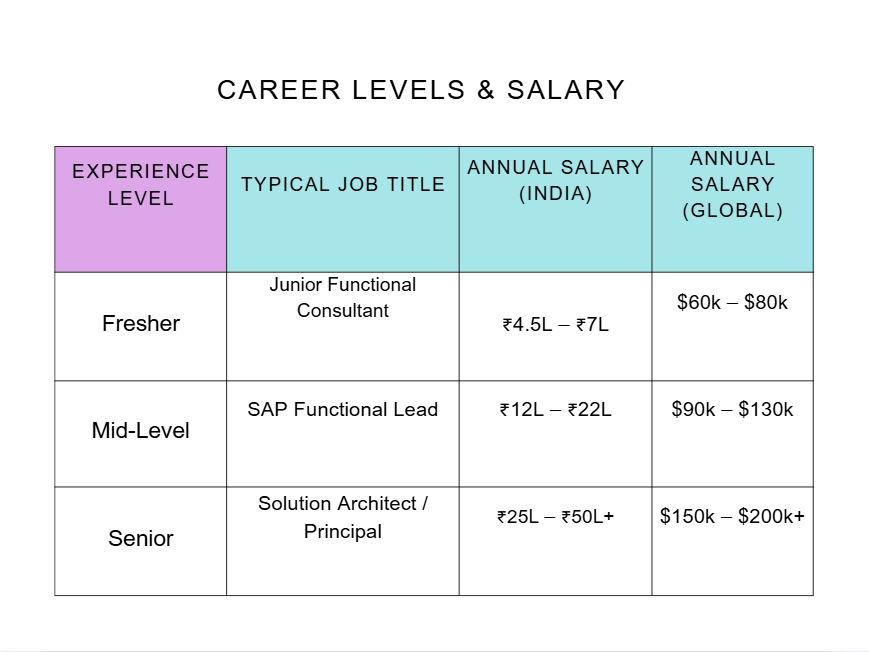
Top 2026 Growth – SAP Functional Modules
- SAP S/4HANA FICO: Always the #1 need. Every company needs finance.
- SAP EWM (Extended Warehouse Management): Growing thanks to e-commerce and automated logistics.
- SAP SuccessFactors (Cloud HR): Server application has been highly demanded as companies are moving HR to the cloud.
2. SAP Technical Career Scope
The opportunities for people are changing to Cloud Development. Simple ABAP as we knew it, is being replaced by SAP BTP (Business Technology Platform), with Fiori. If you like to live on top of the tech world, this is the way.
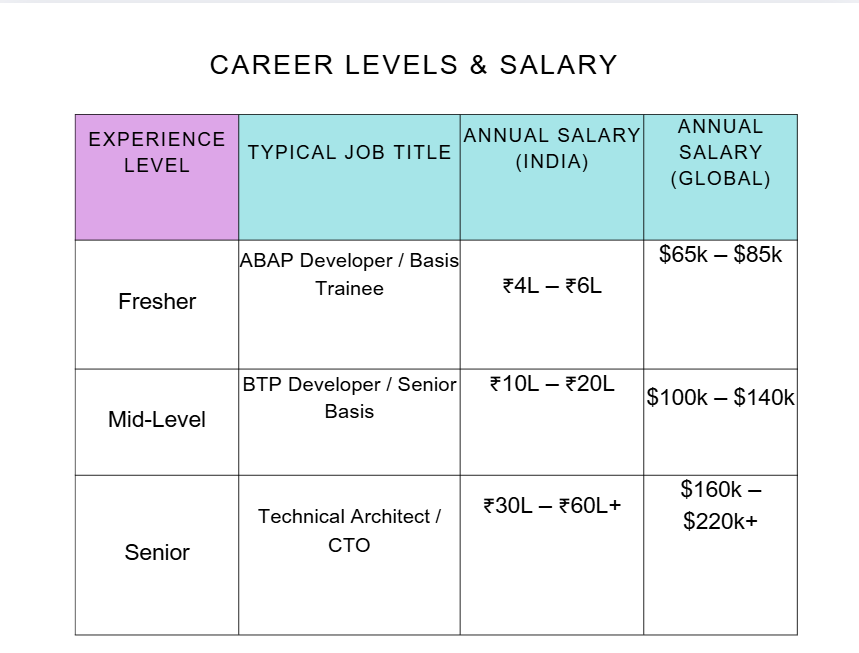
Top 2026 Growth Areas
- SAP BTP & Integration Suite: Organisations use many applications (eg Salesforce, Workday, etc.) now. The one who can make them “talk” to SAP is the most valuable techie in the room.
- SAP Fiori / UI5: for the new image of SAP.
- SAP Security & GRC: With the demand for technical experts who can secure information skyrocketing, individuals with this skill are raking in high-dollar fees.
Eduwatts- Best Platform to Learn SAP Functional Modules and Technical Modules

If you are looking for the best and stil Affordable SAP Training Courses, then Eduwatts is the first name you should consider. Eduwatts is an upskilling and technology academy offering both SAP Functional modules and Technical modules.
The academy emphasises practical SAP training, having served over 12,000 professionals through live interactive sessions, real-time projects, and e-learning platforms. It prioritises a customer-first approach, offering beginner-friendly programs with industry-experienced trainers and job placement support.
What will you get at Eduwatts?
- Training is delivered as two‑way interactive online classes, typically around 44 hours for many modules.
- All trainings include assignments, projects and internships.
- Strong practical orientation, with real‑time projects, case studies and e‑learning access (LMS and mobile), plus reported outcomes such as promotions, role changes and freelance SAP work after completing the courses.
- Highly experienced and expert faculty
- User-friendly LMS
- 24*7 customer support
SAP Modules at Eduwatts
1. SAP Functional Modules
- SAP FICO (Financial Accounting & Controlling)
- SAP AP
- SAP MM
- SAP SD
- SAP PP
- SAP HR
- SAP QM
- SAP PM, and much more
SAP Technical Modules
- SAP ABAP
- SAP HANA
- SAP BASIS,
- SAP Security,
- SAP NetWeaver,
- SAP BW/4HANA,
- SAP BO,
- SAP Analytics Cloud
Conclusion
The distinction between SAP Functional Modules and Technical modules is what makes the system so powerful. Functional modules provide the business intelligence, while Technical modules provide the computational power and flexibility. If you are a business looking to implement SAP, you need a balanced team of both. If you are a professional looking to enter the field, identify whether you are a “Business Thinker” (Functional) or a “System Builder” (Technical). Eduwatts will help you stay up to date with the latest trends in this industry. So call the Eduwatts team today and enrol with us now!
Recommended Reads
- SAP EHS Online Training for Beginners
- How to Find the Best SAP Classes Near Me for Fast Career Growth?
- What Makes the SAP FICO Module the Most Demanded Skill in Finance?
- SAP Course Fees, Eligibility, and Career Scope Explained
- Why the SAP Course in Bangalore is the best for Upskilling?
FAQs
Functional roles are those that require business knowledge, process analysis and configuration skills – a good fit for commerce or MBA grads.
The technical roles (which now include some PP and MM) require programming (ABAP), IT basics, d/base skills and system admin. suited for those with an engineering background.
Both are in-demand; business for business consulting, tech for IT implementations—your choice probably depends on your background and fancy.
Begin with functional if business-minded, or technical if IT-savvy; several pursue both for full-stack SAP skills.
The average online SAP course runs 1-6 months for live programs, about 40-60 hours including projects; self-paced options can be longer or shorter depending on the provider.